Understanding DNA Structure and Function: The Double Helix and Gene Expression
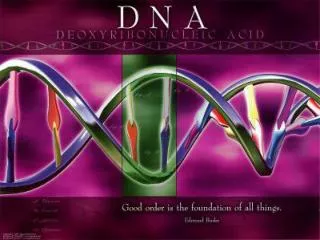
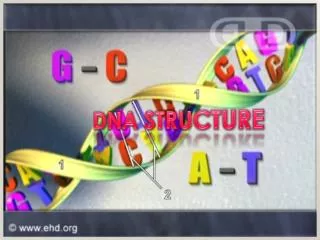
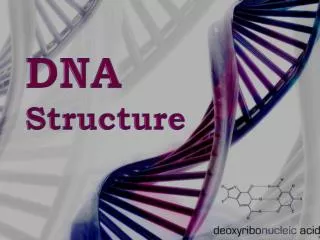
DNA, or deoxyribonucleic acid, consists of two molecules arranged in a double helix structure. Each DNA molecule is composed of millions of nucleotides, which include a phosphate group, pentose sugar, and nitrogenous base. The bases form base pairs: adenine (A) pairs with thymine (T), and guanine (G) pairs with cytosine (C). The order of these bases determines the genetic code found in genes, which are sections of DNA that encode proteins. Understanding the sequence of bases, organized into triplets called codons, is essential for genetic expression and determining unique traits.

Understanding DNA Structure and Function: The Double Helix and Gene Expression
E N D
Presentation Transcript
DNA Structure
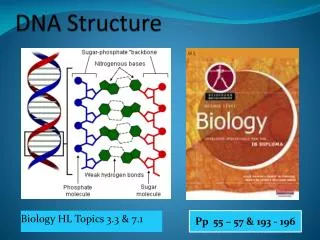
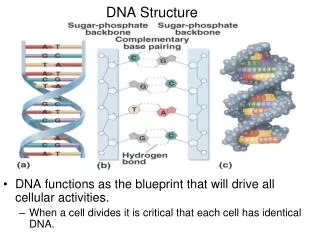
DNA Structure • DNA consists of two molecules that are arranged into a ladder-like structure called a Double Helix. • A molecule of DNA is made up of millions of tiny subunits called Nucleotides. • Each nucleotide consists of: • Phosphate group • Pentose sugar • Nitrogenous base
Nucleotides Phosphate Nitrogenous Base Pentose Sugar
Nucleotides • The phosphate and sugar form the backbone of the DNA molecule, whereas the bases form the “rungs”. • There are four types of nitrogenous bases.
Nucleotides T Thymine A Adenine Guanine G C Cytosine
Nucleotides • Each base will only bond with one other specific base. Adenine (A) Thymine (T) Cytosine (C) Guanine (G) Form a base pair. Form a base pair.
DNA Structure • Because of this complementary base pairing, the order of the bases in one strand determines the order of the bases in the other strand.
Complimentary Bases T T T T A A A A G G G C C C
DNA Structure • To crack the genetic code found in DNA we need to look at the sequence of bases. • The bases are arranged in triplets called codons. A G G - C T C - A A G - T C C - T A G T C C - G A G - T T C - A G G - A T C
DNA Structure • A gene is a section of DNA that codes for a protein. • Each unique gene has a unique sequence of bases. • This unique sequence of bases will code for the production of a unique protein. • It is these proteins and combination of proteins that give us a unique phenotype.
DNA Gene Protein Trait
Your Task • Draw a flow chart to show how to get from: