
Status Update on ERS-2 Satellite and SLR Mission Operations
E N D
Presentation Transcript
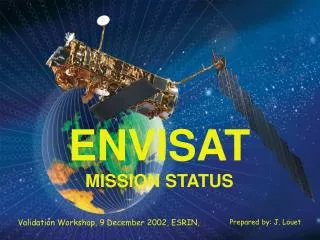
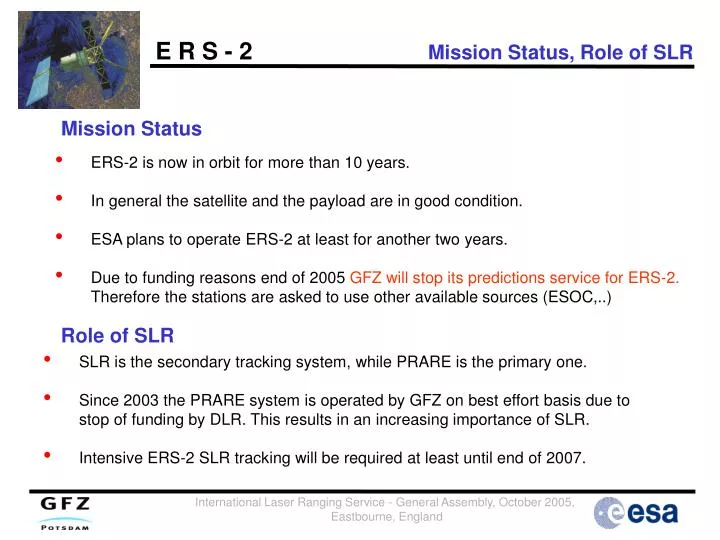
Mission Status, Role of SLR Mission Status • ERS-2 is now in orbit for more than 10 years. • In general the satellite and the payload are in good condition. • ESA plans to operate ERS-2 at least for another two years. • Due to funding reasons end of 2005 GFZ will stop its predictions service for ERS-2. Therefore the stations are asked to use other available sources (ESOC,..) Role of SLR • SLR is the secondary tracking system, while PRARE is the primary one. • Since 2003 the PRARE system is operated by GFZ on best effort basis due to stop of funding by DLR. This results in an increasing importance of SLR. • Intensive ERS-2 SLR tracking will be required at least until end of 2007.
SLR Data Quantity and Quality • Since 2001 the SLR tracking clearly increased, 2001 showing the lowest, 2003 the best since start of the mission • The data quality is in general very good • Still sometimes large outliers when the normal point has been formed from one full-rate observation only