Empowering People with Disabilities: Case Studies on Inclusive Employment in Bangladesh
This case study presents effective practices for socio-economic empowerment of extremely poor people with disabilities in Bangladesh. It emphasizes the importance of beneficiary participation in livelihood processes and incorporates complementary initiatives such as skill development training, technical support for asset transfer, and awareness campaigns. Key measures, including grant provision, strengthening linkages with Disabled People's Organizations (DPOs) and cooperatives, and enhancing access to services, are discussed. Recommendations focus on combining grants with rehabilitation and skill development for sustainable livelihoods.

Empowering People with Disabilities: Case Studies on Inclusive Employment in Bangladesh
E N D
Presentation Transcript
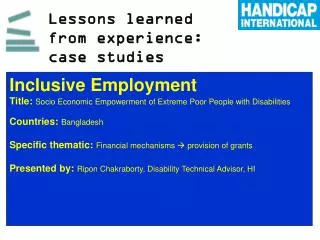
Lessons learned from experience: case studies Inclusive Employment Title: Socio Economic Empowerment of Extreme Poor People with Disabilities Countries: Bangladesh Specific thematic: Financial mechanisms provision of grants Presented by: Ripon Chakraborty, Disability Technical Advisor, HI
Description of the good practices • Participation of beneficiaries and CLWs in livelihood procurement process • Complementary initiatives > Skill development training> technical support to asset transfer > Rehabilitation service> training to CLWs, caregivers and local artisans > Awareness campaign> access to mainstream heath and social services • Networking and linkages> DPOs and local cooperatives> build up saving capacity
Summary of key points • Provision of grants should be recommended for extreme poor people including extreme poor with disabilities • Participation and contribution of the beneficiaries should be compulsory for better ownership • Grants alone are not enough> awareness raising, rehabilitation support and business skill development are needed to reinforce livelihood and other social conditions • Linkages with the DPOs and local cooperatives should be done for buiding saving capacity






![The LIFE LESSONS LEARNED FROM A DANDELION (7) [motive]](https://cdn1.slideserve.com/2228602/the-life-lessons-learned-from-a-dandelion-7-motive-dt.jpg)