Download
1 / 12
130 likes | 253 Views
The Five Pillars of Islam are fundamental acts of worship that shape the life of every Muslim. The Shahadah is the declaration of faith, affirming the oneness of Allah and the prophethood of Muhammad. Salat involves five daily prayers and requires ritual purification through Wudu and Ghusl. Zakat is the obligation of charitable giving, while Sawm signifies fasting during Ramadan to cultivate spiritual discipline. Finally, Hajj is the pilgrimage to Makkah, performed at least once in a lifetime if possible. Together, these pillars define a Muslim's faith and community responsibilities.

E N D
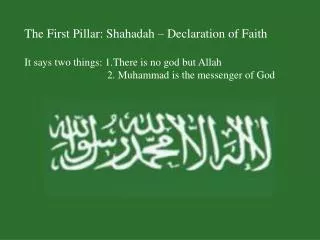
The First Pillar: Shahadah – Declaration of Faith It says two things: 1.There is no god but Allah 2. Muhammad is the messenger of God
The Second Pillar: Salat – Mandatory prayer five times daily Prayers take place: 1.before dawn 2.mid-day 3.late afternoon 4.after sunset 5.after dark
Wudu: Ablution; ritual cleansing of certain parts of the body performed prior to salat prayers, other acts of worship and other religious practices; literally and spiritually means “making pure or radiant” Ghusl: Ritual cleansing of the entire body; an act of purification so that an individual can participate in prayer, attend the mosque or touch the Qur’an
The third pillar: Zakat – Mandatory almsgiving Means “to purify or increase”. Muslims are required to give 2.5 percent of their surplus wealth over the period of one year $50,000 – $20,000 = $30,000 ($30,000)(0.025) = $750 $10 / week $520 Christmas and Easter $200 Total: $720
The fourth pillar: Sawm – Mandatory fasting • Muslims cannot eat, drink, or have sexual relations from dawn until dusk during the month of Ramadan • They abstain from the pleasures in life in order to develop spiritual purity • Special consideration is given to the young and elderly • The month ends with the festival called Eid al-Fitr.
The fifth pillar: Hajj – Mandatory pilgrimage to Makkah If you have the health and the means, you are required to make the trip to Makkah. The last day commemorates the time that God asked Abraham to sacrifice his only son, Ismael.
The Islamic Calendar 1.Muharram 2.Safar 3.Rabi' al-awwal (Rabi' I) 4.Rabi' al-thani (Rabi' II) 5.Jumada al-awwal (Jumada I) 6.Jumada al-thani (Jumada II) 7.Rajab 8.Sha'ban 9.Ramadan 10.Shawwal 11.Dhu al-Qi'dah 12.Dhu al-Hijjah