Fascinating World of Carbon Nanotubes: Properties, Production, and Applications
110 likes | 168 Views
Learn about carbon nanotubes, how they are made, and their intriguing properties such as high strength and thermal conductivity. Discover their potential applications in various technologies.


Fascinating World of Carbon Nanotubes: Properties, Production, and Applications
E N D
Presentation Transcript
Carbon Nanotubes Ray Olang
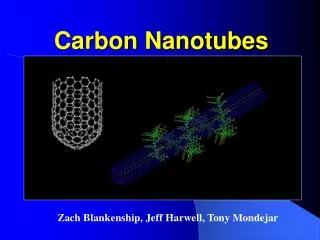
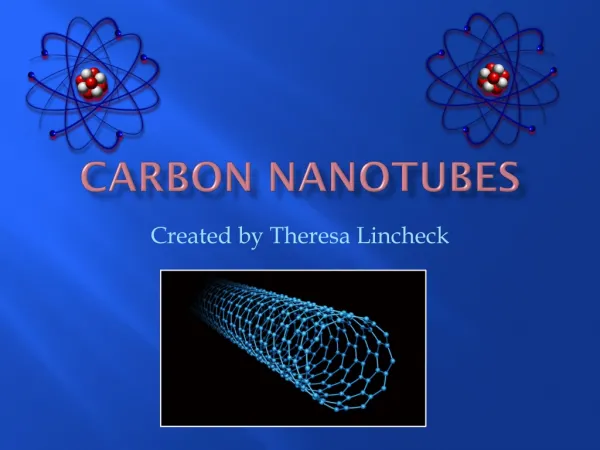
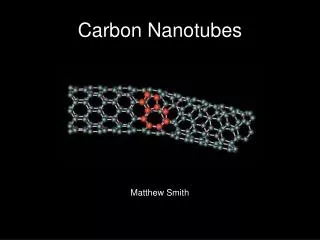
How are they made? • Nanotube formation is allowed because their formation eliminates high-energy dangling bonds and increases strain energy and thus decreasing total energy; the net decrease in energy is what allows the formation of nanotubes along with the addition of energy for the overall reaction.
Yeah, how? • The methods of creating nanotubes are arc discharge, laser ablation, high pressure carbon monoxide, and chemical vapor deposition; most of the methods take place in a vacuum or with process gases.
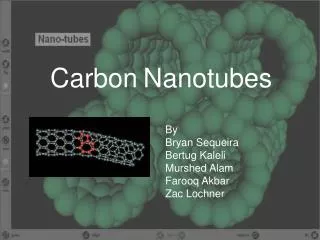
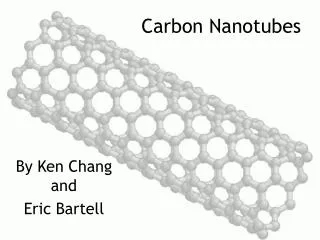
So What? • Can be metallic or semi-conducting depending on orientation (special gate voltage controlled band gaps) • Light, yet strong (more s-character) • The Young's modulus of the best nanotubes can be as high as 1000 GPa(5x stiffer than steel) • The tensile strength 63 Gpa (50x higher than steel) • Own insulation (multi-walled) • All nanotubes are expected to be very good thermal conductors along the tube, but good insulators laterally to the tube axis. • Concentric • SMALL (3000K limit) • Defects lower conductivity • Current density x1000 Silver
Conclusion • Their mechanical properties and unique properties make them both interesting as well as potentially useful in future technologies. waterproof tear-resistant cloth fibers, combat jackets, high-tensile concrete, increasing polymer elasticity, artificial muscles, chemical nanowires, high-speed flywheels, buckypaper, space elevator, filters, etc