Download
1 / 7
70 likes | 163 Views
This article delves into the functional divisions of the medial frontal cortex (MFC) and its role in social cognition. The MFC is divided into three regions - Orbital (orMFC), Anterior (arMFC), and Posterior (prMFC) - each serving unique purposes in processing self-knowledge, perceptions of others, and interpersonal motivations. The functional divisions include action monitoring, self-knowledge, person perception, mentalizing, and evaluating social consequences. The MFC is integral in assessing actions against desires and goals, monitoring emotional states, and attributing mental states to others. Studies suggest that activation in the MFC shifts depending on the task, such as evaluating outcomes, prioritizing actions, and assessing reward values. The article also explores how the MFC processes pain perception, reputation judgments, and regrets. Understanding the complexities of the MFC contributes to a deeper comprehension of social interactions and cognitive processes.

E N D
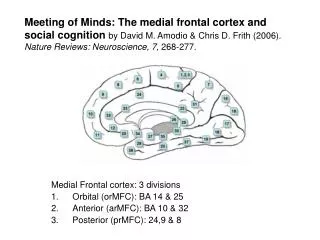
Meeting of Minds: The medial frontal cortex and social cognition by David M. Amodio & Chris D. Frith (2006). Nature Reviews: Neuroscience, 7, 268-277. Medial Frontal cortex: 3 divisions Orbital (orMFC): BA 14 & 25 Anterior (arMFC): BA 10 & 32 Posterior (prMFC): 24,9 & 8
Social cognition: all the processes that deal with knowledge of the self, perceptions of others including their internal somatic and mental states, and interpersonal motivations Functional divisions of MFC Pr MFC: Action monitoring – link between (voluntary) actions and intentions Ar MFC: Self knowledge, person perception, mentalizing oMFC: Evaluating social consequences of outcomes
prMFC: evaluating social consequences of one’s actions Action monitoring and error correction Assessment of actions against desires and goals. Self-selected actions more so than directed ones
arMFC: Self knowledge, person perception, mentalizing Evaluation of self-related traits, attributes, preferences related to self Monitoring of one’s emotional state Thinking about others: as others become more familiar activation tends to move more to the front (anterior-orbital) of arMFC Theory of mind: attributing mental states to others; communicative intention (deception) vs. private intention (false belief which is prMFC)
oMFC: Evaluating social consequences of outcomes Evaluates and prioritizes outcomes of actions Rates reward value of stimuli and responses Deals with outcome itself, monitors actual outcome consequences against anticipated ones. Self-selection less important than prMFC Focus on degree of regret in various outcomes
Studies with pain perception suggest that as activation moves more forward pain is less tied to sensory inputs and interpreted more abstractly. Anterior activation also found when making judgments about reputation of other’s and self