
CELL DIVISION
E N D
Presentation Transcript
Cell Division • One cell Two identical cells • Cells must be able to pass on ALL information from their DNA • So DNA must be replicated before cell division occurs
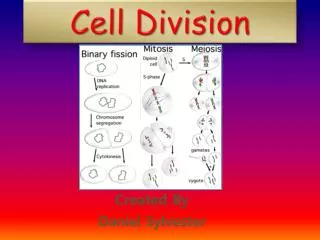
Prokaryotic Cells • No nucleus • DNA is found as circular molecule • BINARY FISSION • DNA replicates • DNA attaches to membrane • Cell pinches & splits
Eukaryotic Cells • Much more complicated • Chromosome – DNA coiled around proteins
Formation of chromosomes • DNA at “rest” found unorganized in nucleus • Just before cell division, it organizes itself into chromosomes
How many do humans have? • Somatic cells = DIPLOID (2n) • 46 chromosomes (23 pairs) • 22 pairs = Autosomes • 1 pair = Sex chromosomes (X & Y) • XX (female) vs. XY (male)
Gametes = HAPLOID (n) Formed from germ cells 23 chromosomes (one of each) Sperm + Egg = Zygote YOU! 23 + 23 = 46 How many do humans have?
Cell Cycle • G1 – 1st Growth – Routine functions • S – Synthesis – DNA Replication • G2 – 2nd Growth – Prepare to Divide • M – Mitosis – Division of the Nucleus • C – Cytokinesis – Division of the Cytoplasm • MOVIE
Cell Cycle • Numerous ways to control speed • Malfunction of cell cycle = cancer
Interphase • Includes the G1, S, & G2 phases • When the cell is not dividing or “at rest” • DNA is found unorganized in the nucleus
Mitosis • Division of the nucleus to form 2 identical nuclei • Chromosome = 2 identical chromatids (formed after replication)
Mitosis • Prophase • Metaphase • Anaphase • Telophase • MOVIE 1 • MOVIE 2
Prophase • Chromosomes become visible • Nuclear envelope dissolves • Spindle forms from centrioles
Metaphase • Chromosomes line up along equator
Anaphase • Chromatids separate and reeled to opposite poles
Telophase • Nuclear envelope forms at each pole • Chromosomes uncoil • Spindle dissolves • Cytokinesis begins
Cytokinesis • Division of the cytoplasm • Animal cells – pinch and split • Plant cells – forms cell plate down the center • MOVIE
Meiosis • Formation of haploid gametes from one germ cell • Homologous chromosomes – chromosomes of similar size, shape, & genetic content
Meiosis • Meiosis I • Prophase I • Metaphase I • Anaphase I • Telophase I • Meiosis II • Prophase II • Metaphase II • Anaphase II • Telophase II
Prophase I • Homologous chromosomes pair up & crossing over occurs • Animation • Allows genetic variation
Prophase I • Chromosomes become visible • Nuclear env. breaks down • Spindle forms • Crossing over
Metaphase I • Pairs of homologous chromosomes move to equator of cell
Anaphase I • Homologous chromosomes reeled to opposite poles
Telophase I • Chromosomes gather at poles • Cytokinesis
Prophase II • New spindle forms
Metaphase II • Chromosomes line up on equator
Anaphase II • Chromatids reeled to opposite poles
Telophase II • Nuclear envelope forms • Cytokinesis
What can go wrong? • Nondisjunction– the chromosomes fail to separate during meiosis • Trisomy – individual has 3 of a particular chromosome • Down syndrome = trisomy 21