Download

1 / 20
200 likes | 310 Views
This exploration highlights the evolution of astronomical theories from the geocentric system, illustrated by Bartolomeu Velho in 1568, to the revolutionary heliocentric model proposed by Nicolaus Copernicus. It discusses the characteristics of the eight planets, emphasizing the sun’s dominant mass and gravitational influence. Learn about the closest planet, Mercury, the immense atmospheric conditions of Venus, and Earth's unique environment that supports life. Discover the outer gas giants, including Jupiter, Saturn, Uranus, and Neptune, and their distinct features, including their moons and rings.

E N D
Geocentric (Earth-centered) System • An illustration of the geocentric system by Portuguese “astronomer” and cartographer (map maker) Bartolomeu Velho, 1568
Nicolaus Copernicus (1473–1543) • mathematician, astronomer, and physician • new idea- heliocentric solar system • regarded as the starting point of modern astronomy
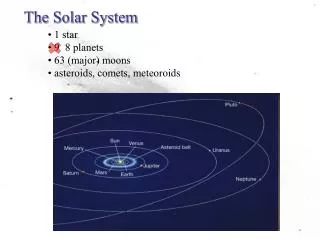
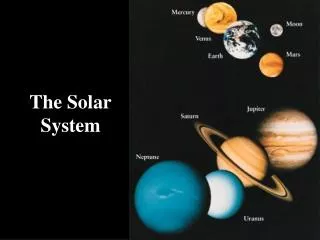
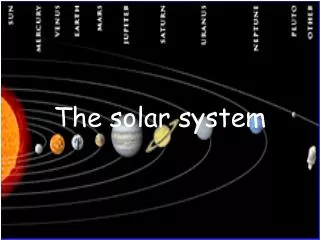
Modern Views of the Solar System • eight planets • sun contains >98 % of the solar system’s mass • the sun’s gravity holds solar bodies in place • formed from a nebula of gas, dust, and ice
Mercury Fly by (1974) Mariner 10 Mercury’s South Pole
Mercury • closest to the sun • extreme temperatures: -170o– 425o C • no atmosphere • iron core
Venus • 2nd from the sun • similar mass & size to Earth • 1962 Mariner 2 mission • Soviet Union landed 1970 • intense greenhouse effect
Earth • 3rd from the sun • abundant H2O • atmosphere causes most meteors to burn up before impact • Ozone (O3) protects from Ultraviolet Radiation
Mars “the red planet” • 4th from the sun • polar ice caps H2O & CO2 • thin atmosphere of CO2 • two moons • multiple missions
Exploration of Mars Viking Lander- 1975 Artist’s Rendition of the Exploration Rover. (Image courtesy of NASA/JPL-Caltech.)
The Outer Planets • gaseous • large • asteroid belt separates the inner/outer planets • Jupiter, Saturn, Uranus, and Neptune
Jupiter • 5th planet • composed mostly of H and He. Some ammonia, CH4, and H2O • liquid layer, rocky core? • “Great Red Spot” • at least 63 moons • Europa – rock and ice
Saturn 6th planet large, gaseous, similar to Jupiter outer atmosphere of H & He liquid layer below small rocky core? 47 moons and rings
Uranus • 7th planet • discovered in 1781 • large, gaseous • 27 moons • rings • H, He, CH4
Neptune • 8th planet • discovered in 1846 • atmosphere of H, He, and CH4
Neptune’s Moon Triton • Triton is the largest moon of the planet Neptune, discovered in 1846 • It is the only large moon in the solar system with a retrograde orbit, opposite direction to its planet's rotation. • At 2700 km in diameter
Bibliographic Websites • http://vfm.jpl.nasa.gov/othervenusmissions/flybymissionsmarinermessenger/ • http://www.astronomyviews.com/mercury.html • http://www.b14643.de/Interplanetary%20Probes/index.htm