Understanding Organism Competition and Ecological Interactions
210 likes | 329 Views
This bellringer activity explores the reasons why organisms compete with each other within their ecosystems. Ecology examines the intricate relationships between organisms and their environment, including how they interact with one another and share resources. Key concepts include the levels of organization—organism, population, community, and ecosystem—as well as the role of symbiosis, predation, and habitat in shaping these interactions. By identifying and understanding these competitive dynamics, we can better appreciate the balance of life in the biosphere.


Understanding Organism Competition and Ecological Interactions
E N D
Presentation Transcript
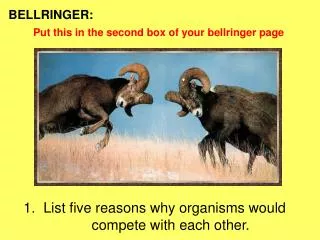
BELLRINGER: Put this in the second box of your bellringer page • List five reasons why organisms would compete with each other.
Section 2.1 Summary – pages 35 - 45 SHARING THE WORLD • Ecology is the study of interactions that take place between organisms and their environment. (Where they live, what they eat, and what eats them)
Section 2.1 Summary – pages 35 - 45 BIOSPHERE • In Biology we study the portion of Earth that supports life- Biosphere • It extends from high in the atmosphere to the bottom of the oceans.
LEVELS OF ORGANIZATION Section 2.1 Summary – pages 35 - 45 • Ecologists have organized the living world into levels— • the organism by itself • population • community • and ecosystem
LEVELS OF ORGANIZATION Section 2.1 Summary – pages 35 - 45 ORGANISM • An individual living thing that is made of cells, uses energy, reproduces, responds, grows, and develops.
LEVELS OF ORGANIZATION Section 2.1 Summary – pages 35 - 45 POPULATION • A population is a group of organisms, all of the same species, which interbreed and live in the same area at the same time.
LEVELS OF ORGANIZATION Section 2.1 Summary – pages 35 - 45 COMMUNITY • A biological community is made up of interacting populations in a certain area at a certain time.
COMMUNITY Section 2.1 Summary – pages 35 - 45 • A change in one population in a community may cause changes in the other populations.
LEVELS OF ORGANIZATION Section 2.1 Summary – pages 35 - 45 ECOSYSTEM • Biological communities that interact with each other in a given area and with the abiotic components of that area.
SYMBIOSIS Section 2.1 Summary – pages 35 - 45 • A relationship between organisms of different species is called symbiosis. • Four kinds of symbiosis are recognized: 1. mutualism, 2. commensalism, 3. parasitism, 4. predator/prey.
SYMBIOSIS Section 2.1 Summary – pages 35 - 45 Mutualism • A symbiotic relationship in which both species benefit is called mutualism.
SYMBIOSIS Section 2.1 Summary – pages 35 - 45 Commensalism • Commensalism is a symbiotic relationship in which one species benefits and the other species is unaffected.
SYMBIOSIS Section 2.1 Summary – pages 35 - 45 Parasitism • A symbiotic relationship one species benefits and the other is harmed is called parasitism.
SYMBIOSIS Section 2.1 Summary – pages 35 - 45 Parasitism • Parasites have evolved in such a way that they harm, but usuallydo not kill the host species. Tape Worms in Intestine
In a predatorand prey relationship one species is benefitted and the other is killed. Predators seek out and eat other organisms. Section 2.1 Summary – pages 35 - 45 • Predation is found in all ecosystems and includes organisms that eat plants and animals.
ORGANISMS IN ECOSYSTEMS Section 2.1 Summary – pages 35 - 45 • A habitat is the place WHERE an organism lives out its life.
ORGANISMS IN ECOSYSTEMS Section 2.1 Summary – pages 35 - 45 A niche is the WAY an organism lives out it’s life— • how it meets its specific needs for food and shelter • how it survives, • and where it reproduces in its environment.
ORGANISMS IN ECOSYSTEMS Section 2.1 Summary – pages 35 - 45 • Why is thought that two species can’t exist for long in the same community if their niches are the same?
Table of Contents: Symbiosis Notes Attach the notes on page 4