Understanding Arthritis: Types, Symptoms, and Treatments
This comprehensive guide covers various types of arthritis, including osteoarthritis, rheumatoid arthritis, reactive arthritis, and crystal-induced arthritis. Learn about the clinical presentations, diagnosis criteria, and effective treatment options for each type. The guide emphasizes the importance of recognizing symptoms such as joint pain, morning stiffness, and swelling while highlighting the significance of proper medical management, including NSAIDs, corticosteroids, and disease-modifying drugs. Stay informed on arthritis management today!

Understanding Arthritis: Types, Symptoms, and Treatments
E N D
Presentation Transcript
ARTHRITIS Anna Jaatinen Rotary Doctor Bank Finland, Ilembula Hospital
Today’s topics • Osteoarthritis • Rheumatoid arthritis • Reactive arthritis • Crystal-induced Synovitis • Infectious Arthritis • HIV-associated arthritis
Rheumatoid arthritis 1 • Systemic diseace • Unknown etiology • Symmetric inflammatory polyarthritis • Extra-articular manifestations • Rheumatoid nodules • Pulmonary fibrosis • Serositis • Vasculitis • Rheumatoid factor up to 80%
Rheumatoid arthritis 2 • Clinical Presentation • Insidous oncet of the pain, swelling and morning stiffness in the joints (hands, wrists) • Synovitis! Typical places: MCP, PIP, wrist • Rheumatoid nodules on extensor surfaces • Course is often chronic and progressive • Erosions! • Rheumatoid arthritis may substatial long-term disability and is associated with increased mortality!
Rheumatoid arthritis 3 • American Collece of Rheumatology 1987 Classification Criteria • Morning stiffness (>60 min) • Arthritis of three of more joints • Arthritis of hand joints • Rheumatoid nodules • Serum rheumatoid factor • X-ray changes (erosions and decalcification) • 4 of the 7 criteria should be met, with criteria 1 to 4 present for more than 6 weeks
Rheumatoid arthritis 4 TREATMENT • NSAID • Ibuprofen 400-800 mg TDS as long as needed • Acetylsalicylic acid • Corticosteroids • Prednison 5 to 20 mg OD • With long treatments remember to decrease the dose slowly! • Intra-articulr administration • Hydrocortison 25-100 mg i.a. • DMARDs (Diseace-modifying antirheumatic drugs) • Methotrexate • Hydroxychloroquine • Sulfasalazine • Leflunomide • Biologic DMARDs Patients with itractable symptoms may require special treatment at spesialist centre!
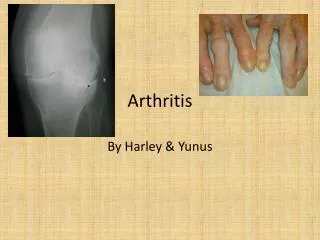
Osteoarthritis 1 = Degenerative joint disease = Arthrosis • Most common form of arthritis! • Degenerative loss of articular cartilage with subsequent formation of reactive new bone at the cartilage surface • Most common: PIP, DIP, hips, knees, cervical and lumbar spine • Common in the elderly, but may occur any age especially after joint trauma, chronic inflammatory arthritis or congenital malformation.
Osteoarthritis 2 • Clinical Presentation • Pain! • Specific clinical features depend on the joint involved • Knee: possible hydrops, no signs of infection or severe inflammation • DIP: enlarged joint Bouchard’s nodes • X-ray shows cartilage damage and sometimes even deformity
Osteoarthritis 3 TREATMENT • Nonpharmacologic approaches • Prief period of rest • Good shoes: Walkers • Crepe bandage or brace can help • Physiotherapy and exercise to affected joints • Reduction on weight in obese patients • Medications • Paracetamol 1 g TID (QID) • NSAID (As low dose as possible) • Ibuprofen 200-600 mg TID • Itra-articular clucocorticoid • Should not be given more than every 3 to 6 months • Systemic clucocorticoid should be avoided!
Reactive arhtritis 1 • Inflammatory arthritis, which occasionally follows certain GI or genitourinary infections • Reiter sdr = arthritis + conjuctivitis + urethritis • Most common after • Chlamydia trachomatis, Shigella flexneri, Salmonella species, Yersinia enterocolitica, Campylobacter jejuni • Genetic predisposition • HLA-27 positive 60-80%
Reactive arthritis 2 • Clinical Presentation • Asymmetric oligoarthritis • Urethritis • Conjuctivitis • Skin and mucous lesions • Usually transient, lastin one to several months • Some patients develope chronic arthritis
Reactive arthritis 3 TREATMENT • Control of pain and inflammation! • NSAIDs • Severe cases short glucocorticoid therapy • Ophthalmologic referral if you suspect iritis • Remember and search for infection! • Clamydia tr • Antibiotic treatment if still needed • Prolonged antiobiotic therapy has NOT been showed to be beneficial
Crystal-Induced Arthritis 1 • Gout (Urate crystals) • Pseudogout (Calcium pyrophosphate dihydrate crystals) • Apatite disease • Gout arthritis developes when urate crystals deposites in the joints • Primary: hyperuricemia due to undersecretion of uric acid • Secondary: Renal disease, diuretic therapy, low-dose aspirin, ethanol, starvation, lactic asidosis, dehydration, pre-eclampsia, diabetic ketoasidosis
Crystal Induced Arthritis 2 • Clinical Presentation • Excruciating pain • Usually in single joint in foot or ankle • Occasionally a polyarthritic oncet can mimic rheumatoid arthritis • Joint is swollen, skin erythema, warm/hot • Chronic gout: With time acute gouty attacs more often, even chronic joint deformity may appear • Lab: Uric acid levels with 70%, Crystals seen in the joint fluid examined with microscope
Crystal Induced Arthritis 3 TREATMENT • Acute gout • NSAID high dose • Indomethacin 75 mg start then 50 mg every 6 hours 24 hrs, 50 mg TDS 24 h, 25 mg TDS 24 h • Diclofenac 75 mg BDS • Ibuprofen 400-800 mg TDS • Glucocorticoids (especcially when NSAID is contraindicated) • Intra-articular injection • Prednison 40 mg OD 3-5 days • Colchisine • 1 mg stat followed 0,5 mg every 2 hours orally until patient improves or ad 10 mg • Prevention • Anti-hyperuricaemic therapy; Allopurinol • Goal serum uric acid below 8 mg/dl (0.48 mmol/l) • Avoid precipitants (alcohol, small fish, diuretics) • Reduce weight in obese patients Remember that allopurinol can make acute gout even worse! Start after clinical improvement!
Infectious Arthritis 1 • Septic infection! • Non-conococcal: Staphylococcus Aureus, Streptococci • Conococcal arthritis • Occasionally: M Tuberculosis, Brucella, Fungi • Non-bacterial infectious arthritis • Viral infections: Hepatitis B, Rubella, Mumps, Mononucleosis, parvovirus, enterovirus, adenovirus
Infectious Arthritis 2 • Clinical Presentation • Non-gonococcal infectious arthritis • Fever • Acute monoarticular arthritis • Multiple joint may be affected by hematogenous spread of pathogens • Gonococcal arthritis • Migratory or additive polyarthralgias followed by tenosynovitis or arthritis of wrist, ankle or knee and vesicopustular skin lesions
Infectious Arthritis 3 TREATMENT • Immediate antibiotic therapy • Cover S. Aureus, Streptococcus, Neisseria gonorrhoeae • IV-antibiotics are recommended for at least 2 weeks, followed by oral antibiotics 2(-4) weeks • When definite gonococcal arthritis Ceftriaxone i.v. For 3 days followin 7-14 days treatment with cefixime or Amoxicillin/clavulanate • Surgical drainage especcially if there is big joint (shoulder, hip), lobulation of pus, osteomyelitis or delay with response to treatment • Supportive treatment for septic infection! • NSAID
HIV-infection and arthritis 1 • HIV-associated arthralgia • Any stage of HIV infection • Mild to moderate, involves usually large joints (shoulders, elbows, knees) • No synovitis! • Treatment: Pain medication, support
HIV-infection and arthritis 2 • Reactive arthritis • Psoriatic arthritis • HIV-assosiated arthritis • Virus is directly involving joint synovium • Oligoarticular, occurs predominantly in the lower extremities • Self-limiting course, lasting <6 weeks • X-ray: no erosion in the joints • Also HIV-associated polyarthritis is possible, resembles rhematoid arthritis • Synovitis abates when CD4 is declining, but joint destruction continues
Diagnose with intra-articular puncture Main principles • Clear synovial fluid: Osteoarthritis, Rheumatoid arthritis • Leukocyte amount • Thick, fuzzy: Crystal-induced Arthritis • Crystals seen in microscope • Purulent: Infectious arthritis • Culture, Gram stain Assure that your technique is clean!
Take Home Message • Osteoarthritis is the most common reason for joint pain; treat the pain and educate the patient • Treat with antibiotics when… • It’s infectious arthritis! • Reactive arthritis if there still is infection • If you suspect Rheumatoid arthritis, treat aggressively, consider refferal for specialist Asante, Thank you!