Title VII and Partnership: Legal Distinctions Between Partners and Employees
30 likes | 148 Views
This text explores the nuances of Title VII protections for partners versus employees, referencing key legal cases such as Hishon v. King & Spaulding and Clackamas Gastroenterology Associates, P.C. v. Wells. It examines the criteria that determine an individual's employment status, including the common law test, which looks at organizational control and supervision, and other legal tests like the economic realities test. Understanding these distinctions is crucial for assessing rights under Title VII in partnership contexts and determining eligibility and protections.


Title VII and Partnership: Legal Distinctions Between Partners and Employees
E N D
Presentation Transcript
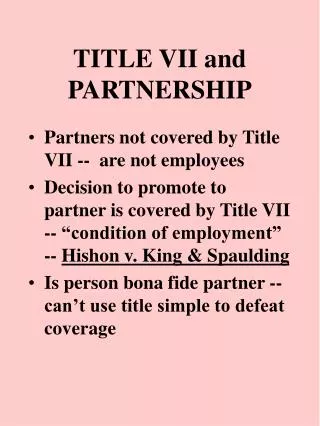
TITLE VII and PARTNERSHIP • Partners not covered by Title VII -- are not employees • Decision to promote to partner is covered by Title VII -- “condition of employment” -- Hishon v. King & Spaulding • Is person bona fide partner -- can’t use title simple to defeat coverage
Partner or Employee? • “Common Law Test” – Clackamas Gastroenterology Assocs., P.C. v. Wells [123 S.Ct. 1673 (2003)]: • Can the organization hire/fire or set rules to control the individual’s work? • Does the organization supervise the individual’s work – to what extent? • Does the individual report to someone higher up the organization? • Whether and to what extent is the individual able to influence the organization? • Did the parties intend the individual to be an employee – in contract or agreement? • Does the individual share in the profit/loss and liabilities of the organization?
Other Legal Tests • “Economic Realities” Test -- look to factors to determine status: • participation in profit / loss • investment in firm • exposure to liability • partial ownership of firm assets • voting rights • direction and management of firm • “Per Se” approach where firm is corporation • Both were rejected by the Court in Clackamas