Download
1 / 39
390 likes | 527 Views
Explore the complexities of nuclear energy, including the differences between renewable and non-renewable resources, the fundamental concepts of radiation, and the management of nuclear waste. Learn about the types of radiation emitted by unstable atoms and the genetic and somatic effects of radiation exposure. Delve into nuclear fission and fusion processes, and the challenges of safely storing radioactive waste that can remain hazardous for thousands of years. Understand the implications of nuclear disasters and the ongoing debate about energy production and environmental safety.

E N D
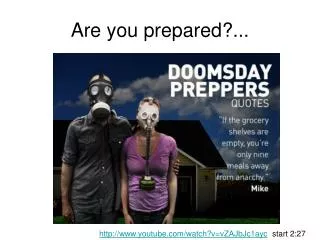
Are you prepared?... http://www.youtube.com/watch?v=vZAJbJc1ayc start 2:27
What is Radiation? Uranium 92U238.02891 How many protons? How many electrons? How many neutrons? 6 C Carbon 12.011 92 protons 92 electrons 146 neutrons
What is Radiation? • Radiation = particles given off by unstable atoms. • 3 Types: • Alpha (α) • Travels few inches • Blocked by paper (skin) • Beta (β) • Travels few feet • Blocked by aluminum, glass • Gamma (γ) • Travels far • Blocked by lead (steel & concrete).
Background Radiation • The amount of radiation we are exposed to daily from the environment • Average = 360 millirem/year or 3 millisieverts
www.geology.fau.edu/course_info/fall02/ EVR3019/Nuclear_Waste.ppt
Effects of Radiation • Genetic damages: from mutations that alter genes • defects can become apparent in the next generation • Somatic damages: to tissue, such as burns, miscarriages & cancers www.bio.miami.edu/beck/esc101/Chapter14&15.ppt
Nuclear waste • Power plants produce radioactive wastes • mostly spent fuel rods (3-4 years) • each reactor produces about 20-30 tons yearly • Currently stored in pools on site and then above ground casks • some remain dangerous for tens of thousands of years • How should we store this waste?
Options for Waste • Keep onsight • Bury • Shoot into space • Bury in ocean floor • Bury in Antarctica • Change it into harmless or reprocess to make new fuel
Low-Level & High Level Radioactive Waste Emit small amounts of ionizing radiation Stored 100-500 years 19401970: put in steel drums, dumped in ocean (still UK & Pakistan) 1970+: gov’t run landfills • Stored for thousands of years • Mostly spent fuel rods (240,000 yrs) • Safety debate • Options: • Keep onsight • Bury • Shoot into space • Bury in ocean floor • Bury in Antarctica • Change it into harmless
Nuclear Energy • The energy that exists within the nucleus of an atom. • Nuclear Fission = the release of energy from the splitting of atoms! • Nuclear Fusion = the combining of two smaller atoms into one larger atom. • http://videos.howstuffworks.com/discovery/29389-assignment-discovery-nuclear-basics-video.htm
Nuclear Fission http://www.youtube.com/watch?v=Pmy5fivI_4U
Nulear Change Nuclear Fission Nuclear Fusion Sun and stars, some weapons 2 small (light) isotopes are forced together H + H = He Need temps > 100,000,000ºC Releases more E than fission • Bombs & power plants • Big, unstable isotopes are struck by neutrons, which splits the isotope’s nuclei • More neutrons “shoot out” to strike nearby isotopes, causing a chain reaction.
437 commercial reactors in 32 countries, producing 17% electricity
Nuclear Power Plant a controlled nuclear fission chain reaction heats water produce high-pressure steam that turns turbines which turns generator and creates electricity. http://www.howstuffworks.com/nuclear-power2.htm
http://www.animatedsoftware.com/environm/nukequiz/nukequiz_one/nuke_parts/reactor_parts.swfhttp://www.animatedsoftware.com/environm/nukequiz/nukequiz_one/nuke_parts/reactor_parts.swf www.bio.miami.edu/beck/esc101/Chapter14&15.ppt
Pressurized Water Reactor Boiling Water Reactor
Where nuclear fission occurs. Surrounded by thick concrete, steel & lead. Blocks all radiation! Nuclear Reactor
Fuel Rods 35,000 – 70,000 fuel rods 3% Uranium-235 pellets In water (moderator) Control Rods absorb extra neutrons Control the chain reaction Inside the Reactor http://online.wsj.com/article/SB10001424052748704396504576205000098975380.html#project%3DFUELASSEMBLY0317%26articleTabs%3Dinteractive
Cooling Tower • Water is the coolant in the system. • Tower is used to condense hot steam to liquid water. • Usually taken from river, lake, ocean. • Water can be reused.
Decommissioning Life span of a power plant = 15-40 years Parts wear out, Fuel is spent Plant is shut down Highly radioactive for 240,000 years Must store for 10 times the half-life What can we do with them?
Half-Life = time needed for one-half of the nuclei in a radioisotope to decay and emit their radiation to form a stable isotope Half-time emitted Uranium 235 710 million yrs alpha, gamma Plutonium 239 24,000 yrs alpha, gamma www.bio.miami.edu/beck/esc101/Chapter14&15.ppt
When people think about nuclear power they think about… • Effects of radiation • Nuclear waste disposal • Nuclear disasters
Three Mile Island - 1979 • .008 sieverts over 7 days • Remember 1,000 sieverts is radiation sickness • 5,000 is death http://maps.google.com/maps?um=1&hl=en&q=three%20mile%20island%20plant%20map&ndsp=20&safe=on&ie=UTF-8&sa=N&tab=il
Chernobyl - 1986 • 300 sieverts per hour • 240 acute radiation sickness; 31 died within 3 months • 100,000 people evacuated • Some claim up to 985,000 deaths due to Chernobyl
Japan • 0.4 sieverts per hour • 70,000 people evacuated • 140,000 told to stay inside
http://streaming.discoveryeducation.com/search/assetDetail.cfm?guidAssetID=BE0FB49C-7C70-4C56-95F2-B3904BC9077Fhttp://streaming.discoveryeducation.com/search/assetDetail.cfm?guidAssetID=BE0FB49C-7C70-4C56-95F2-B3904BC9077F • 10 min video on nuclear energy • Fission, fusion, overview