The Enlightenment: Exploring Governance, Science, and Society (1650-1800)
170 likes | 285 Views
The Enlightenment, a transformative period from the 1650s to 1800, challenged traditional authority and promoted new ideas about governance, religion, and science. Key questions emerged: Who should govern a nation? What role should religion play in government? How crucial is science for societal progress? The era highlighted thinkers such as Hobbes, Locke, and Rousseau, advocating for reason and rights. This intellectual movement laid the foundation for modern concepts of democracy and individual liberties, reshaping European social and political landscapes.


The Enlightenment: Exploring Governance, Science, and Society (1650-1800)
E N D
Presentation Transcript
The Enlightenment 1650ish-1800
Essential Questions: • Who should govern a nation? • How powerful/pervasive should that force of government be? • What’s the role of religion in society? • Should religion have a place in government? • How important is science to society?
Middle Ages • Europe: Feudalistic society • Kings had divine right to rule • No way to break free from the hierarchy—constraining
Renaissance Humanism • People are capable of thinking for themselves. • Individual Education (Humanities: grammar, rhetoric, Greek, history, moral philosophy, poetry) Erasmus, Holbein
Later Issues (15-1700s) • Absolute monarchs • Government out of touch with its constituents • Nearly impossible to advance socially (no rags to riches) • Aristocracy became ruling class with advent of parliamentary systems of gov’t Louis XIV (1638-1715)
“L’état, c’estmoi.” “The state is me,” Louis XIV
The Three Estates, France • 17th century • First estate: Louis XVI and clerics, most resources. Did not pay taxes. • Second estate: Noblemen and women, self-centered. Did not pay taxes. • Third estate (largest): Workers, artisans, etc. Did most of the work. Tax burden fell exclusively on them. No representation.
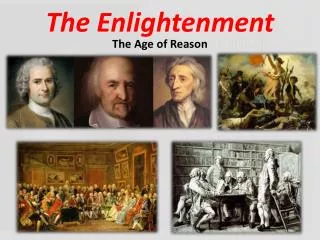
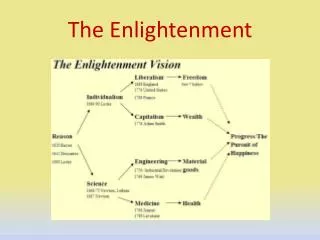
The Enlightenment • Occurred between approximate years of 1650s-1800 • Explosion in radical thought about organization of society and purpose of government • Value of Experimenting • Oxygen was named during this time period as was the idea of the element. • Lack of care for national borders • Philosophes • Descartes, Hobbes, Locke, Voltaire, Newton, Rousseau, Montesquieu
Thomas Hobbes, 1588-1679 • Absolutist • Leviathan (1651) • All individuals are naturally equal, but… • Leviathan=sea monster that devoured ships…used here as a symbol for the government., created to impose order
John Locke, 1632-1704 • Tabula Rasa: blank slate • Importance of environment and reason vs. heredity and faith • No “divine right” • Man has natural rights: • Life • Liberty • Property • Gov’t that doesn’t approve should be abolished.
Baron de Montesquieu, 1689-1755 • Believed in three branches of government with checks and balances
Jean-Jacques Rousseau, 1712-1778 • Wrote about distaste for political and economic oppression • Good of the community > the individual • Government determined by its citizens
Exit Ticket • On your index card: • Briefly compare the Three Estates with the Middle Ages. • What is one of the Enlightenment’s essential questions? • What are philosophes? Name at least one. • Make sure you include your name.
Sources • http://enlightenmentreed.wetpaint.com/page/Causes+of+the+Enlightenment • http://www.google.com/imgres?um=1&hl=en&safe=off&sa=N&authuser=0&biw=1272&bih=611&tbm=isch&tbnid=8VKNFAg6sprH5M:&imgrefurl=http://www.iep.utm.edu/rousseau/&imgurl=http://www.iep.utm.edu/wp-content/media/rousseau.jpg&w=199&h=264&ei=TzE8UIKoE4qBrAHp3oG4CQ&zoom=1&iact=rc&dur=722&sig=104433060286746596077&page=1&tbnh=111&tbnw=86&start=0&ndsp=28&ved=1t:429,r:0,s:0,i:142&tx=45&ty=53 • http://www.fhs.d211.org/departments/socialstudies/mzacharia/200910%20APUSH%20Enlightenment%20Lecture.pdf • http://www.google.com/imgres?um=1&hl=en&safe=off&sa=N&authuser=0&biw=1272&bih=611&tbm=isch&tbnid=jXfCXei7VlTwxM:&imgrefurl=http://en.wikipedia.org/wiki/Leviathan_(book)&imgurl=http://upload.wikimedia.org/wikipedia/commons/thumb/d/db/Leviathan_gr.jpg/200px-Leviathan_gr.jpg&w=200&h=307&ei=sDM8UIaXBYKdqQGrg4HABA&zoom=1&iact=rc&dur=393&sig=104433060286746596077&page=1&tbnh=119&tbnw=77&start=0&ndsp=23&ved=1t:429,r:5,s:0,i:170&tx=42&ty=48 • http://www.google.com/imgres?um=1&hl=en&safe=off&sa=N&authuser=0&biw=1272&bih=611&tbm=isch&tbnid=LrVJo4rXBgnqyM:&imgrefurl=http://en.wikipedia.org/wiki/John_Locke&imgurl=http://upload.wikimedia.org/wikipedia/commons/thumb/d/d1/JohnLocke.png/220px-JohnLocke.png&w=220&h=284&ei=xDM8UM6mL4e2qAHr2YCYCg&zoom=1&iact=rc&dur=299&sig=104433060286746596077&page=1&tbnh=122&tbnw=95&start=0&ndsp=27&ved=1t:429,r:0,s:0,i:129&tx=40&ty=30 • http://www.google.com/imgres?um=1&hl=en&safe=off&sa=N&authuser=0&biw=1272&bih=611&tbm=isch&tbnid=G8C7kDTDCiyfvM:&imgrefurl=http://www.constitution.org/cm/sol.htm&imgurl=http://www.constitution.org/img/montesquieu.jpg&w=658&h=867&ei=3TM8UJSWG8ji2QX5v4DgDA&zoom=1&iact=hc&vpx=247&vpy=144&dur=314&hovh=258&hovw=196&tx=99&ty=131&sig=104433060286746596077&page=1&tbnh=116&tbnw=87&start=0&ndsp=27&ved=1t:429,r:1,s:0,i:119 • http://www.google.com/imgres?start=45&num=10&um=1&hl=en&safe=off&authuser=0&biw=1272&bih=647&tbm=isch&tbnid=5hHnBIKkPUa_9M:&imgrefurl=http://ridgeaphistory.wikispaces.com/European%2BFeudalism&imgurl=https://fc.deltasd.bc.ca/~csharpe/FOV2-0005D480/S017BC870.1/feudal-system.gif&w=287&h=384&ei=EDQ8UOKdJof7qgHrn4CADw&zoom=1&iact=hc&vpx=525&vpy=122&dur=407&hovh=210&hovw=155&tx=99&ty=142&sig=104433060286746596077&page=3&tbnh=159&tbnw=115&ndsp=25&ved=1t:429,r:14,s:45,i:127 • http://www.google.com/imgres?um=1&hl=en&safe=off&sa=N&authuser=0&biw=1272&bih=611&tbm=isch&tbnid=u6W9PwHptYOz8M:&imgrefurl=http://en.wikipedia.org/wiki/Desiderius_Erasmus&imgurl=http://upload.wikimedia.org/wikipedia/commons/thumb/8/89/Hans_Holbein_d._J._047.jpg/270px-Hans_Holbein_d._J._047.jpg&w=270&h=357&ei=KzQ8UMivHqbe2AWWvICoDQ&zoom=1&iact=hc&vpx=178&vpy=153&dur=471&hovh=129&hovw=104&tx=108&ty=129&sig=104433060286746596077&page=1&tbnh=117&tbnw=95&start=0&ndsp=27&ved=1t:429,r:0,s:0,i:142 • http://en.wikipedia.org/wiki/File:Louis_XIV_of_France.jpg