Download
1 / 11
110 likes | 233 Views
In this lecture, we explore advanced concepts in matched models, focusing on interactions with matching variables and the formulation of additive models. We discuss the potential pitfalls of ignoring matching effects and emphasize the importance of diagnostics for ensuring model efficiency. Additionally, we delve into the challenges of fitting additive models in software like Stata, highlighting the necessity of specialized packages for accurate statistical analysis. Understanding effect modification by matching variables is critical for robust data interpretation and model accuracy in biostatistics.

E N D
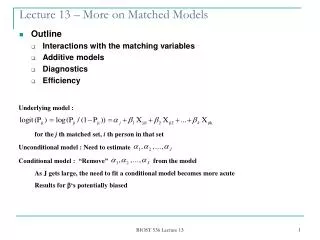
Lecture 13 – More on Matched Models • Outline • Interactions with the matching variables • Additive models • Diagnostics • Efficiency BIOST 536 Lecture 13
Leisure world data • Neither ignoring the matching nor fitting individual αj for each matched set is a good idea BIOST 536 Lecture 13
Effect modification by the matching or stratifying variables BIOST 536 Lecture 13
Interactions with the matching variables BIOST 536 Lecture 13
Interactions with the matching variables BIOST 536 Lecture 13
Additive models BIOST 536 Lecture 13
Additive models • As is often the case, the interaction term allows OR ( A=1 & B=1) < OR(A=1) x OR(B=1) • Suggests an additive model without interaction might be as good • Stata cannot fit the additive model without writing a special routine; some specialized packages (Egret; Epicure) can do these model fits BIOST 536 Lecture 13
Additive models • Additive models can be attractive scientifically, but in practice are difficult to fit and have poor statistical properties BIOST 536 Lecture 13
Diagnostics BIOST 536 Lecture 13
Diagnostics BIOST 536 Lecture 13
Efficiency BIOST 536 Lecture 13