Evolutionary Variations
Explore the wonders of evolution with our engaging quiz that delves into the distinctive traits of various species, including blue whales, hummingbirds, dogs, and Venus flytraps. Learn about the adaptations that allow these creatures to thrive in their environments, such as the whale's blowhole for breathing air, a dog's claws for grip, and the unique features of cacti for water retention. This fun and educational video quiz challenges your knowledge on evolutionary variations and encourages exploration of the animal kingdom!

Evolutionary Variations
E N D
Presentation Transcript
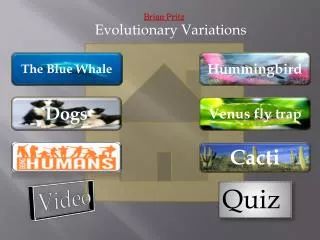
Brian Pritz Evolutionary Variations The Blue Whale Hummingbird Dogs Venus fly trap Cacti Quiz Video
blow hole • Fins • Blubber • Blow Holes • Lives in Water • Tail
Fur • Four Legs • Tails • Big Ears • Claws
Walks on Two Legs • Upright Posture • Rib Cage • Large Brain to Body Weight Ratio • Opposable thumbs
Wings • Bright colors • Tail Feathers • Tiniest Feathered Animal • Long, thin bills
Green and Red • Produces Nectar • Contain sensitive hairs • Grows Roots Under Ground • Crisscrossing Teeth
Spines that Grow above Ground • Green • Roots under ground • Thorns • Waxy surfaces
What is a whales blow hole used for? A) Breathing Water B) Swimming C) Breathing Air D) Communicating
Why do dogs have claws? A) To look pretty B) For eating C) For fighting D) To Grip the ground while running, walking or chasing prey.
Why do humans walk on two legs? A) To save energy and free up hands for other uses B) To look and feel different from other animals C) To make it easier to play basketball D) So sneakers and jeans would look “cooler”
Why do hummingbirds have long, Thin bills? A) To obtain nectar form flowers B) To stab prey C) To drink from a glass without a straw D) To look like it’s smoking a cicarette
Why do Venus fly traps have crisscrossing teeth? A) To capture Prey B) To stab prey C) To look scary D) To keep bugs away
Why do Cacti have waxy surfaces? A) To keep water out B) To help burn more slowly C) For cosmetic purposes D) To help retain water