Understanding Lipids: Fatty Acids, Waxes, Triglycerides, and Steroids
This chapter delves into lipids, a diverse group of organic compounds characterized by their solubility properties. Lipids are insoluble in water but soluble in organic solvents, encompassing fatty acids, waxes, triglycerides, and steroids. Fatty acids, consisting of long hydrocarbon chains, can be saturated or unsaturated. Waxes serve various functions in nature, providing waterproofing and protection. Triglycerides, important dietary fats, are esters of glycerol, with fats being solid at room temperature and oils liquid. The chapter also covers the health implications of cholesterol and lipoproteins.

Understanding Lipids: Fatty Acids, Waxes, Triglycerides, and Steroids
E N D
Presentation Transcript
CHAPTER 13 LIPIDS
LIPID fatty acids waxes steroids triglycerides Lipids • A heterogeneous class of naturally occurring organic compounds classified together on the basis of common solubility properties. • insoluble in water, but soluble in organic solvents • .
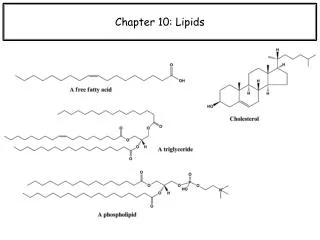
FATTY ACIDS • Carboxylic Acid with long hydrocarbon tail
FATTY ACIDS • Usually straight chains (no branching) • Sizes usually range from C10 to C20 • Usually have an even number of carbons • Can be saturated (no C=C bonds) or unsaturated (has C=C bonds)
Monounsaturated – one C=C Polyunsaturated- more than one C=C
Molecular Shapes C=C causes “kinking” of the carbon chain
SATURATED • Can pack closely together • High Melting point • Solid • Animal fat • UNSATURATED • Kinks prevent close contact • Lower Melting point • Liquid • Plant and fish oil
WAXES • Ester formed from a long chain carboxylic acid (fatty acid) and a long chain alcohol
BEESWAX-Glands under the abdomen of bees secrete a wax, which they use to construct the honeycomb. The wax is recovered as a by-product when the honey is harvested and refined. LANOLIN - The grease obtained from the wool of sheep during the cleaning or refining process is rich in wax BIRD WAXES -Special glands of birds secrete waxes that consist largely of wax esters. The main purpose of the waxes is to give a water-proof layer to the feathers. MARINE WAXES - Waxes appear to have a variety of functions in fish, from serving as an energy source to insulation and buoyancy. PLANT WAXES -The wax provides protection from disease and insects, and helps the plants resist drought.
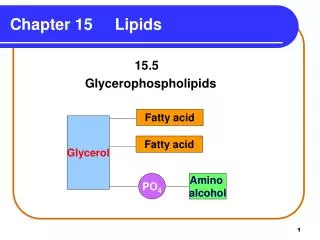
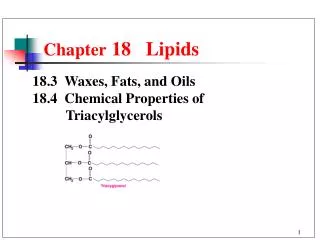
FATS AND OILS • Fats and oils are triglycerides which are triesters of glycerol. • Fats Usually from animal sources. Are solids at room temperature. Contain a high degree of saturated fatty acids. • Oils Usually from plant and fish sources. Are liquids at room temperature. Contain more unsaturated fatty acids.
TRANS ISOMER CIS ISOMER
Raises level of bad cholesterol (LDL) • Decreases level of good cholesterol (HDL) • Arteries become clogged • Increase in strokes • and heart attacks
REACTIONS OF TRIGYLCERIDES HYDROLYSIS
SAPONIFICATION • Hydrolysis using a base to give glycerol and 3 • fatty acid salts (soap)
EMULSIFYING AGENTS • Oil and vinegar salad dressing • Mayonnaise Hollandaise sauce • Chocolate Soap/detergent • Lotions Creams
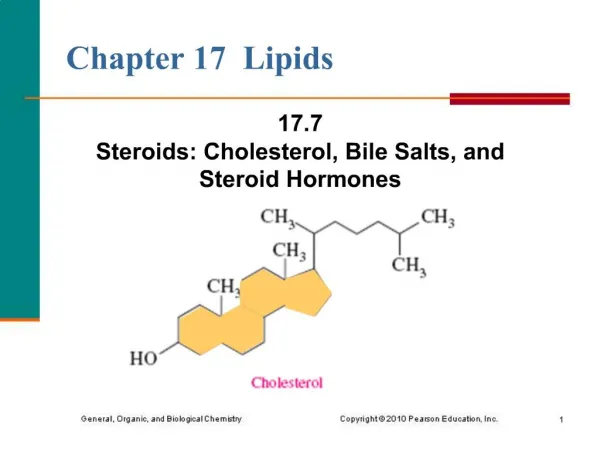
STEROIDS A broad class of compounds that have the same structural feature:
Most abundant steroid in the human body. Essential component of cell membranes. Precursor of other important steroids. CHOLESTEROL • Synthesized by liver and present in foods. • Strong correlation between cholesterol blood levels and atherosclerosis.
HIGH DENSITY LIPOPROTEINS (HDL) More protein; less cholesterol Transports cholesterol from cells back to the liver LOW DENSITY LIPOPROTEINS (LDL) Less protein, more cholesterol Transports cholesterol from the liver to cells