Download
1 / 24
240 likes | 350 Views
This research explores the implementation of the Regional Ocean Modeling System (ROMS) using a 4D-Var assimilation framework for the California Current System. It details the methodologies for correcting initial conditions and boundary forces to reduce model errors, analyzing both primal and dual formulations. The study employs various observational data sources like CalCOFI and GLOBEC to assess the impacts of assimilation cycles on transport and temperature dynamics. It also discusses the Lanczos formulation's advantages for optimization and sensitivity analysis in ocean modeling.

E N D
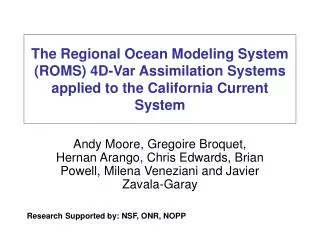
The Regional Ocean Modeling System (ROMS) 4D-Var Assimilation Systems applied to the California Current System Andy Moore, Gregoire Broquet, Hernan Arango, Chris Edwards, Brian Powell, Milena Veneziani and Javier Zavala-Garay Research Supported by: NSF, ONR, NOPP
initial condition increment corrections for model error boundary condition increment forcing increment The Incremental Control Vector fb(t), Bf ROMS bb(t), Bb xb(0), B State vector: x=(T,S,u,v,z)T Controls: initial conditions, x(0) surface forcing, f(t) boundary conditions, b(t)
initial condition increment corrections for model error boundary condition increment forcing increment Cost/Penalty: Tangent Linear Model Obs Error Cov. Innovation Prior error covariance The Incremental Control Vector fb(t), Bf ROMS bb(t), Bb xb(0), B
Primal vs Dual Formulation ROMS has primal and dual 4D-Var options & strong vs weak constraint Analysis: Gain (primal): Gain (dual):
Primal vs Dual Formulation Analysis: Gain (primal): Gain (dual):
Primal vs Dual Formulation The Lanczos formulation of the CG algorithm lends considerable utility to 4D-Var: Analysis: Gain (primal): Gain (dual): Vp = matrix of Lanczos vectors of the Hessian Vd = matrix of dual Lanczos vectors
Primal vs Dual Formulation The Lanczos formulation of the CG algorithm lends considerable utility to 4D-Var: • Posterior (analysis) error variance (dual) • Posterior (analysis) error EOFs (dual) • Observation impact (primal & dual) • Observation sensitivity (dual) Analysis: Gain (primal): Gain (dual):
fb(t), Bf bb(t), Bb xb(0), B Previous assimilation cycle ROMS: California Current System (CCS) COAMPS forcing ECCO open boundary conditions 30km, 10 km & 3 km grids, 30- 42 levels Veneziani et al (2009) Broquet et al (2009)
Observations (y) CalCOFI & GLOBEC/LTOP SST & SSH Ingleby and Huddleston (2007) TOPP Elephant Seals ARGO
Total DI DI SSH DI SST DI XBT DI T CTD DI T Argo DI S CTD DI S Argo DI TOPP Total N N SSH N SST N XBT N T CTD N T Argo N S CTD N S Argo N TOPP Observation Impact (37N transport, 0-500m) 7 day assim cycle (strong) Transport Increment Nobs
Total DI DI SSH DI SST DI XBT DI T CTD DI T Argo DI S CTD DI S Argo DI TOPP Total N N SSH N SST N XBT N T CTD N T Argo N S CTD N S Argo N TOPP Observation Impact (37N transport, 0-500m) 7 day assim Cycle (strong) Transport Increment Nobs
Total DI Total DI DI SSH DI SSH DI SST DI SST DI XBT DI XBT DI T CTD DI T CTD DI T Argo DI T Argo DI S CTD DI S CTD DI S Argo DI S Argo DI TOPP DI TOPP Obs Impact vs Obs Sensitivity Impact Transport Increment 7 day assim cycle (strong) Sensitivity: based on adjoint of 4D-Var Transport Increment
Total DI Total DI DI SSH DI SSH DI SST DI SST DI XBT DI XBT DI T CTD DI T CTD DI T Argo DI T Argo DI S CTD DI S CTD DI S Argo DI S Argo DI TOPP DI TOPP Obs Impact vs Obs Sensitivity Impact Transport Increment 7 day assim cycle (strong) Sensitivity: based on adjoint of 4D-Var Transport Increment
Expected Posterior Error SST 75m
Expected Posterior Error SST 75m Posterior variance – Prior variance
Gulf of Alaska NJ Bight Philippine Archipelago California Current Intra-Americas Sea East Australia Current Current Applications
Primal vs Dual Space (I4D-Var vs 4D-PSAS vs R4D-Var) 1 - 4 July, 2000 (1 outer, 75 inner, Lh=50 km, Lv=30m, Obs errors: SSH 2 cm SST 0.4 C hydrographic 0.1 C 0.01psu) Jmin (Slow convergence of dual form also noted by El Akkraoui and Gauthier, 2009) July 2000: 4 day assimilation window STRONG vs WEAK CONSTRAINT
Jmin i.c. = initial condition wind = wind stress Q = heat flux (E-P) = freshwater flux b.c. = open boundary conditions (R4DVAR: 1 outer-loop; 75 inner-loops)
SSH error SST error ROMS 4D-Var in the CCS no assim 4D-Var forecast
ROMS 4D-Var Diagnostics The Lanczos formulation of the CG algorithm lends considerable utility to 4D-Var: Analysis: Gain (primal): Gain (dual): Vp = matrix of Lanczos vectors of the Hessian Vd = matrix of dual Lanczos vectors
ROMS 4D-Var Diagnostics The Lanczos formulation of the CG algorithm lends considerable utility to 4D-Var: • Posterior/Analysis error variance (dual) • Posterior/Analysis error EOFs (dual) • Observation impact (primal & dual) • Observation sensitivity (dual) Analysis: Gain (primal): Gain (dual):
Assimilation impacts on CC No assim Time mean alongshore flow across 37N, 2000-2004 (30km) IS4D-Var (Broquet et al, 2009)
Analysis Increment: upper 500 m Transport at 37N 5 – 11 April, 2003 Number of Obs 980 obs (6%) Nobs NSST NSSH NT NS NT NS NT NS NT XBT CalCOFI GLOBEC ARGO 11 April, 2003 Sv 0.49Sv (63%) T S T S T S T Total SST SSH XBT CalCOFI GLOBEC ARGO