Understanding Public Key Encryption: Key Exchange and Semantic Security
130 likes | 276 Views
Dive into the fundamentals of public key encryption with this comprehensive course led by Dan Boneh. This module focuses on Alice and Bob's quest to establish a shared secret that remains confidential from potential eavesdroppers. Learn the definition, construction, and significance of algorithms involved in public key encryption, including how randomized algorithms generate key pairs and maintain semantic security. Explore challenges like man-in-the-middle attacks and gain insights into related works, including Merkle Puzzles and formal models of key exchange for a thorough grasp of cryptographic principles.


Understanding Public Key Encryption: Key Exchange and Semantic Security
E N D
Presentation Transcript
Online Cryptography Course Dan Boneh Basic key exchange Public-key encryption
Establishing a shared secret • Goal: Alice and Bob want shared secret, unknown to eavesdropper • For now: security against eavesdropping only (no tampering) Alice Bob eavesdropper ?? This segment: a different approach
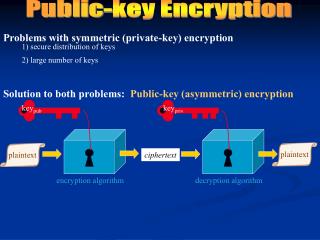
Public key encryption Alice Bob E D
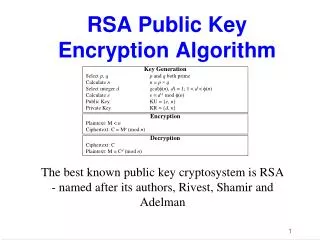
Public key encryption Def: a public-key encryption system is a triple of algs. (G, E, D) • G(): randomized alg. outputs a key pair (pk, sk) • E(pk, m): randomized alg. that takes m∈M and outputs c ∈C • D(sk,c): det. alg. that takes c∈Cand outputs m∈M or ⊥ Consistency: ∀(pk, sk) output by G : ∀m∈M: D(sk, E(pk, m) ) = m
Semantic Security m0 , m1 M : |m0| = |m1| c E(pk, mb) pk b’ {0,1} For b=0,1 define experiments EXP(0) and EXP(1) as: Def: E =(G,E,D) is sem. secure (a.k.a IND-CPA) if for all efficient A:AdvSS[A,E] = |Pr[EXP(0)=1] – Pr[EXP(1)=1] | < negligible b Chal. Adv. A (pk,sk)G() EXP(b)
Establishing a shared secret Alice Bob (pk, sk) ⟵ G() “Alice”, pk choose random x ∈ {0,1}128
Security (eavesdropping) Adversary sees pk, E(pk, x) and wants x ∈M Semantic security ⇒ adversary cannot distinguish {pk, E(pk, x), x } from {pk, E(pk, x), rand∈M} ⇒ can derive session key from x. Note: protocol is vulnerable to man-in-the-middle
Insecure against man in the middle As described, the protocol is insecure against active attacks Alice Bob MiTM “Alice”, pk (pk, sk) ⟵ G() (pk’, sk’) ⟵ G() choose random x ∈ {0,1}128 “Bob”, E(pk, x) “Bob”, E(pk’, x)
Public key encryption: constructions Constructions generally rely on hard problems from number theory and algebra Next module: • Brief detour to catch up on the relevant background
Further readings • Merkle Puzzles are Optimal,B. Barak, M. Mahmoody-Ghidary, Crypto ’09 • On formal models of key exchange (sections 7-9) V. Shoup, 1999