Discrete Probability Distributions
140 likes | 326 Views
This overview covers the essentials of discrete probability distributions, including random variables, probability mass functions (pmf), and cumulative distribution functions (cdf). A random variable transforms elements of a sample space into numerical values, while a discrete random variable has a finite or countable sample space. The properties of pmf, including non-negativity and normalization, are crucial, as well as the definition and calculation of mathematical expectation and variance. Understanding these concepts is fundamental for analyzing and modeling random phenomena.


Discrete Probability Distributions
E N D
Presentation Transcript
Discrete Probability Distributions • A sample space can be difficult to describe and work with if its elements are not numeric. • Random Variable • A random variable is a function that assigns each element in the sample space to a number. • The random variable X has range: • {x|x=X(s), for all s in S}. • More than one random variable can be associated with an experiment.
Discrete Random Variable • A discrete random variable is a random variable that has a finite or countable sample space. • A sample space that can be mapped to the integers is said to be countably infinite (or countable).
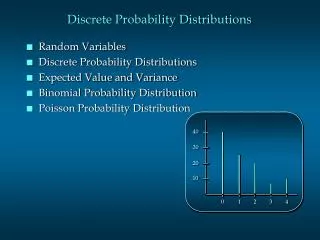
Probability Distribution • The probability distribution of a rv describes the distribution of total probability to all possible values of the rv. • A discrete probability distribution, called a probability mass function (pmf), specifies the probability of each distinct element in the sample space. p(x) = P( X = x ) = P(all s in S: X(s)=x)
Properties of p(x) • p(x)≥0 for all x in S • ∑S p(x) = 1 • If A is a subset of S, then P(A) = ∑A p(x) Note: A pmf can be displayed nicely with a line graph or a probability histogram.
Cumulative Distribution Function (cdf) • The cdf of a discrete random variable X with pmf p(x) is defined for each x as: F(x) = P( X ≤ x ) = ∑y:y≤x p(y) • For any number x, F(x) is the probability that the rv X will be at most x. • The graph of F(x) for a discrete rv is a step function. • For any two numbers a and b with a ≤ b, P( a ≤ x ≤ b ) = F(b) – F(a-) where a- represents the largest value of X less than a
Mathematical Expectation • The mathematical expectation (expected value) of a discrete rv is the weighted average of all possible values of the rv, where the weight associated with each outcome is its probability. • The Expected Value of X • Let X be a discrete rv with pmf p(x). The expected value (or mean value) of X is: E[X] = µx = µ = ∑S x · p(x)
Mathematical Expectation • The Expected Value of a Function of X • Let X be a discrete random variable with pmf p(x). The expected value of a function h(x) is E[h(X)] = µh(x)= ∑S h(x) · p(x) • Note that E[h(x)] only exists if ∑S h(x) · p(x) converges, therefore exists.
Properties of E[X] • If c is a constant, then E[c] = c. • If c is a constant, then E[cX] = c·E[X]. • If c and d are constants, then E[cX+d] = c·E[X]+d. • If c is a constant and u(x) is a function, then E[c·u(X)] = c·E[u(X)].
Properties of E[X] • Property of a Linear Operator • If ci are constants and ui(x) are functions, then E[c1·u1(X)+c2·u2(X)+…+cn·un(X)] = c1·E[u1(X)] + c2·E[u2(X)] + … + cn·E[un(X)] = ∑i=1,n ci · E[ui(X)]
Variance of Discrete RV • Let X be a discrete random variable with pmf p(x). The Variance of X is • The variance of X measures the amount of spread in the distribution of X.
Variance of a Discrete RV • Easier forms for the variance of X include:
Standard Deviation • Let X be a discrete random variable with pmf p(x). The Standard Deviation of X is the square root of the Variance of X. • The standard deviation is commonly used as the measure of spread in a distribution
Variance of a Function • Let X be a discrete rv with pmf p(x). The variance of a function h(X) is:
Variance of a Function • If a and b are constants and Var(X)=σ2, then • Var( a·X ) = a2 · σ2 • Var( X+b ) = σ2 • Var( a·X+b ) = a2· σ2