Download
1 / 15
150 likes | 266 Views
This text delves into the terminology and mechanisms of enolization, focusing on carbonyl compounds. It explains the reference atom, the designations of carbons around the carbonyl carbon (α, β, γ, etc.), and how hydrogens are designated similarly. The document explores the general mechanism of enolization, including acid-catalyzed processes, emphasizing the stability of keto vs. enol forms. Specific examples, like 2,4-pentanedione and 2,4-cyclohexadienone, illustrate the concepts of enol content and stability in various compounds.

E N D
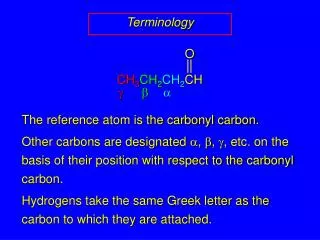
O CH3CH2CH2CH Terminology • The reference atom is the carbonyl carbon. • Other carbons are designated a, b, g, etc. on the basis of their position with respect to the carbonyl carbon. • Hydrogens take the same Greek letter as the carbon to which they are attached. g b a
H •• O H O •• •• •• R2C CR' H O H •• •• H Mechanism of Enolization(In general)
•• O •• R2C CR' H •• O H •• R2C CR' Mechanism of Enolization(In general)
H •• O H O •• •• + H R2C CR' H Mechanism of Enolization(Acid-catalyzed)
Mechanism of Enolization(Acid-catalyzed) H + •• H O O •• •• H R2C CR' H
Mechanism of Enolization(Acid-catalyzed) + •• H O R2C CR' H
H O •• •• H Mechanism of Enolization(Acid-catalyzed) + •• H O R2C CR' H
•• H O •• R2C CR' H + O H •• H Mechanism of Enolization(Acid-catalyzed)
OH O R2CHCR' R2C CR' Enol Content • percent enol is usually very small • keto form usually 45-60 kJ/mol more stablethan enol keto enol
OH O CH3CH H2C CH OH O CH3CCH3 H2C CCH3 Enol Content K = 3 x 10⁻⁷ K = 6 x 10⁻⁹
O OH H H H H H H H H H H H 2,4-Cyclohexadienone • keto form is less stable than enol form • keto form is not aromatic • enol form is aromatic
O OH O O CH3C CH3CCH2CCH3 CHCCH3 1,3-Diketones(also called b-diketones) Example: 2,4-pentanedione • keto form is less stable than enol form (20%) (80%)
Enol form of 2,4-pentanedione intramolecular hydrogen bond 103 pm 166 pm H O O 133 pm 124 pm C C H3C C CH3 134 pm 141 pm H C=C and C=O are conjugated