Nervous System
Nervous System . Delanie Cyr Jacob Butcher Jacklyn Jaronik Claudia Bishop. Nervous system: Central and Peripheral. The Nervous system is stream lined to send rapid signals from cell to cell to maintain homeostasis and coordinate body organs and functions. Central and Peripheral Systems.

Nervous System
E N D
Presentation Transcript
Nervous System Delanie Cyr Jacob Butcher JacklynJaronik Claudia Bishop
Nervous system: Central and Peripheral • The Nervous system is stream lined to send rapid signals from cell to cell to maintain homeostasis and coordinate body organs and functions.
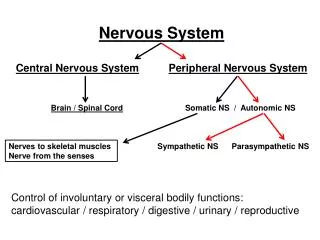
Central and Peripheral Systems • There are two basic types of nervous systems: • CNS (Central Nervous System) • PNS (Peripheral Nervous System)
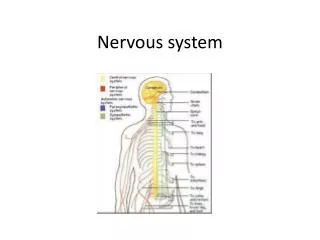
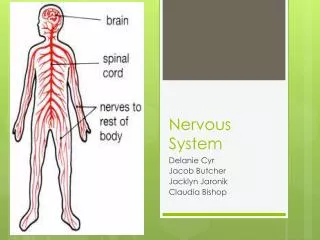
Central Nervous System • Consists of the brain and spinal cord • It coordinates information received from sensory receptors and initiates responses
Peripheral Nervous System • Contains a afferent division composed of sensory receptors and sensory neurons, and an efferent division composed of motor neurons.
Sensory Receptors and Motor Nerves • Sensory receptors detect changes in the environment and transmits this information along sensory or afferent nerves to the CNS • Motor nerves transmits impulses from the CNS to the PNS
Structure of Nervous Tissue • Located in the brain, spinal cord, ganglia, and nerves. • It is composed of two types of cells, Neurons and Neuroglia • Neurons conduct action potentials and are the structural and functional units of nervous tissue • Neuroglia are cells that support, protect, and furnish nutrients to neurons, and augment the speed of neuron transmission
Structure of a Neuron • Can be over 3 feet long (longest nerve in your body) • Three basic parts to a neuron: • Dendrites- receive information from receptors or other neurons and send it back out to the cell body • Cell Body-usually has a triangular or cone shaped area called the axon hillock • Axon- extends from the axon hillock, is the elongated fiber that extends from the cell body to the terminal endings and transmits the neural signal.
Structure of a Neuroglia Cell • Generally smaller and more abundant the neurons. • Six types of neuroglia cells, four located in the CNS, and two located in the PNS. • CNS: • Astrocytes • Oligodendrocytes • Microglia • Ependymal Cells • PNS: • Schwann Cells • Satellite Cells
Classification of a Neuron • Three classifications of a neuron based on their function: • Sensory(afferent)- changes the stimulation into an action potential or nervous impulse that travels along the axon to a spinal cord. • Interneuron- structurally a multipolar neuron and comprises about 90% of the neurons in the CNS. • Motor neuron (efferent)- takes the impulse out of the spinal cord via a spinal nerve to an effector.