Understanding Neurons: Structure, Function, and Role in the Nervous System
Neurons are the fundamental units of the nervous system, responsible for transmitting information throughout the body. They work by generating action potentials and communicating across synapses. This article explores the different types of neurons and their functions, the role of neuroglial cells like astrocytes and microglia, and the significance of myelin sheaths in both the central and peripheral nervous systems. Learn how neurons process stimuli, the mechanisms behind saltatory conduction, and the intricate interactions at the neuromuscular junction.

Understanding Neurons: Structure, Function, and Role in the Nervous System
E N D
Presentation Transcript
Neurons • Neurons and neuroglia (multiple sclerosis and neuroglia) • Where are neurons in the body? • Types of neurons and their functions • How do neurons work? • Action potentials • Synapses
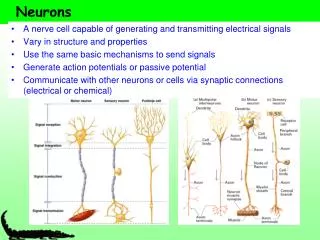
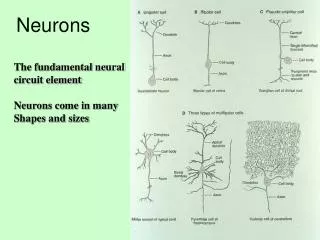
Cell body with nucleus Axon (carries message) Note Schwann cells Dendrites (bring stimulus to cell body) Axonal terminus The Basics of a Neuron
Neurons and neuroglial cells • Axon in peripheral nervous system with myelin sheeth formed by Schwann cells • Provides for insulation and allows for saltatory propagation of action potentials
Neuroglial cells in CNS • Astrocytes • Most abundant and versatile • Control chemical environment around neurons • Also signal among themselves with slow chemical signals • Microglia • Monitor health of neurons and transform into immune macrophages (normal immune cells have no access to CNS) • Ependymal cells • Line cavities of brain/CNS • Barrier between CSF and tissue fluid • Cilia beat to move CSF • Oligodendrocytes • Myelin sheaths in CNS
What happens at the end—chemical synapse • Neuro-muscular junction is synapse between motor unit and muscle cell (motor unit)