Understanding DNA Structure and Protein Synthesis: From Transcription to Translation
This guide explores the fundamental processes of DNA structure and protein synthesis, detailing the roles of nucleotides—comprising sugar, phosphate, and nitrogen bases—in constructing DNA. We delve into transcription, where DNA's genetic code is transcribed into mRNA, creating a blueprint for protein synthesis. The translation process is outlined, showing how ribosomes and tRNA translate mRNA codons into amino acids, forming polypeptides. Key differences between prokaryotic and eukaryotic cells are also highlighted, emphasizing the coupling of transcription and translation in prokaryotes.

Understanding DNA Structure and Protein Synthesis: From Transcription to Translation
E N D
Presentation Transcript
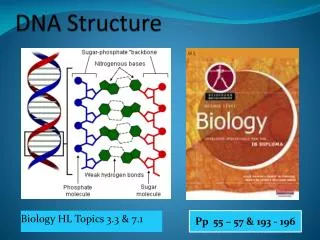
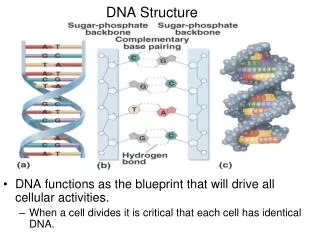
DNA Structure
Protein Synthesis: Transcription & Translation
Transcription: Making a copy of the blueprint
Using the Genetic Code: DNA :: mRNA :: Protein • Get from ‘language’ of DNA (A,G,C,orT) to ‘language’ of protein (aa’s) • DNA’s ‘language’ is a triplet code in which 3 nucleotide bases (a codon) specify 1 amino acid in protein.
Steps in Transcription
Transcription: Note the free nucleotides
mRNA- final product of Transcription mRNA moves off to ribosome
Translation Building the protein from the plan
Using the Genetic Code: DNA :: mRNA :: Protein • Get from ‘language’ of DNA (A,G,C,orT) to ‘language’ of protein (aa’s) • DNA’s ‘language’ is a triplet code in which 3 nucleotide bases (a codon) specify 1 amino acid in protein.
Structure of a tRNA
Translation: purple = mRNA blue = ribosome yellow = tRNA (note anticodon) white = amino acids red = peptide bond
A Polysome: With more than one ribosome translating an mRNA at one time, it is possible to produce many polypeptides simultaneously from a single mRNA.
Protein Synthesis
In a prokaryotic cell, transcription and translation are coupled; that is, translation begins while the mRNA is still being synthesized. In a eukaryotic cell, transcription occurs in the nucleus, and translation occurs in the cytoplasm.