Download
1 / 13
220 likes | 342 Views
This guide explores the different registers of language we use in various contexts, highlighting how we adjust our speech based on our audience. It poses reflective questions about communication: Do you speak differently at home compared to school? How do you address friends versus adults? Understanding these registers—frozen, formal, consultative, casual, and intimate—is crucial for effective and appropriate interactions. Learning this can enhance academic and professional success while avoiding miscommunication in social situations.

E N D
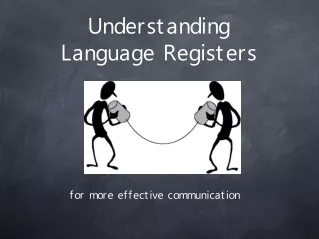
UnderstandingLanguage Registers • for more effective communication
Some questions regarding communication • Do you speak the same way at home as you do in a classroom? • Do you speak the same way with your friends as you do to an adult family member? a family member who is your age? who is a child? • Do you speak differently when you are talking to a teacher or a doctor as you do with your friends
We all speak differently in different situations! • These different ways of speaking are called registers of language. • The English language has five registers.
Language Registers • Those who do not acquire it, must learn it in order to be academically (and probably professionally successful. • When people do not understand or use the correct register, they run the risk of offending another person. • Using the appropriate or inappropriate register reflects positively or negatively upon us.
Which would you use? • Other terms for “death” • passed away • kicked the bucket • others?
Frozen Register • Characteristics • Static language - does not change • Used by when and by whom • Dead languages • Prayers • Ritual • Historical Documents
Formal (does not mean fancy) • Characteristics? • Standard English used in one way communication (lecture) • Focuses on correct form • Tends to be impersonal • Stresses unity and organization • Speaker/writer delivers all information • Used when and by whom? • Academic (and professional) English • Formal presentations • Written text for a general audience (newspapers, magazines)
Consultative • Characteristics? • Standard English used in two-way communication • Addressee participates • Speakers all provide background information • Used when and by whom? • Strangers interacting • Adults at work • Students in class (the goal)
Casual (informal) • Characteristics? • Little or no background information • Use of slang or vulgar language • Used when and by whom? • Friends or peer group • Insider, code words used • Personal writing
Intimate • Characteristics? • Excludes others • Has its own code/shorthand • Participants are expected to be able to fill in all the blanks • Not always verbal • Used when and by whom? • Husband/wife • Twins • Family members
A Universal Rule • A person can go from one register to the next register without any conflicts whatsoever. • However, if a person goes from one register to another, skipping a level or more, this is considered anti-social behavior.
Another rule • Public Registers • Frozen • Formal • Consultative • Private Registers • Casual • Intimate
Your task • Between now and class Monday observe different people and how they communicate • Identify three language registers being used, who was using it; how did you know which register was being used; was it appropriate and why or why not?