Nervous System
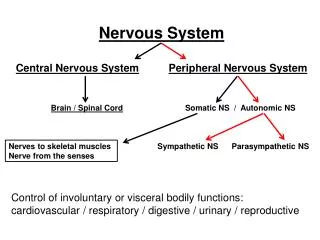
This overview delves into the critical functions of the nervous system, highlighting sensory input via afferent fibers, integration processes for interpreting stimuli, and motor output transmitted through efferent fibers. It explains the roles of neurons as structural units, detailing their long lifespan, high metabolic rate, and electrical signaling capabilities. Additionally, it distinguishes between ganglia in the PNS and nuclei in the CNS, explores action potentials involving K+, Na+, Ca++, and Cl-, and discusses myelination by Schwann cells and the differences between white and gray matter.


Nervous System
E N D
Presentation Transcript
Nervous System A.P. Biology
Nervous System Fxns • Sensory input (Stimulus sent via Afferent fibers) • Integration • Motor output (Response sent via Efferent fibers)
Functions: • Sensory input – internal and external stimuli • Integration – interpretation of sensory input • Motor output – response
Neurons Structural units of the nervous system Composed of a body, axon, and dendrites Long-lived, a-mitotic, and have a high metabolic rate Their plasma membrane functions in electrical signaling
Nuclei vs ganglia • Clusters of cell bodies in the CNS are called nuclei • Clusters of cell bodies in the PNS are called ganglia
K+ Na+ Ca++ Cl-
Scwann cells • Form myelin sheath of PNS
White matter vs gray matter • White matter is myelinated • Gray matter is unmyelinated • Dendrites are always unmyelinated