Understanding Arthropods: Diverse Creatures of the Exoskeleton
Arthropods, including insects, crabs, and spiders, belong to the Phylum Arthropoda, characterized by segmented bodies, tough exoskeletons, and jointed appendages. This unique grouping highlights essential similarities despite their vast differences. Arthropods grow by molting, shedding their old exoskeleton for a new one. Key classifications include Mandibulates and Chelicerates, with distinct features such as branched antennae and specialized mouthparts. Discover the fascinating adaptations and variations in this diverse group of organisms, including their roles in ecosystems.

Understanding Arthropods: Diverse Creatures of the Exoskeleton
E N D
Presentation Transcript
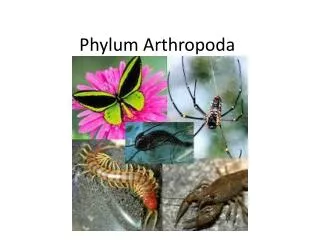
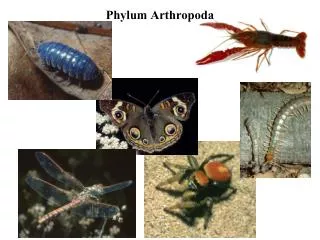
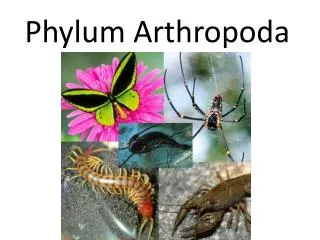
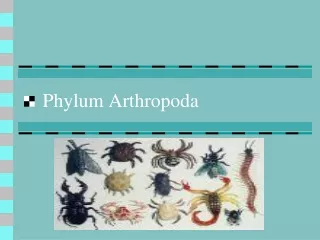
What are arthropods? • Insects • Crabs • Spiders
Why are they grouped even though they are so different? • All have segmented bodies • Tough exoskeleton • Jointed appendages
Question • What does “exo” mean – hint it means the same thing as “ecto”
Exoskeleton • Tough outside covering • armor • Made from protein and a carbohydrate • CHITIN
Question • How do arthropods grow if they have tough exoskeletons, that don’t grow?
Answer • Arthropods molt – means they shed their exoskeleton and grow a new one • http://www.youtube.com/watch?v=DdpNBOiRbgg
Question • What is an appendage?
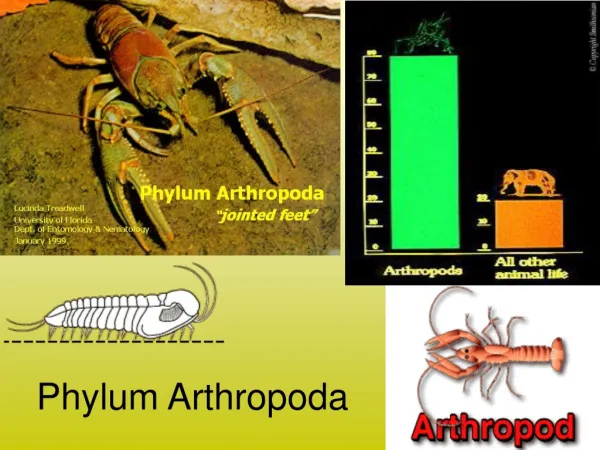
Appendages • Arthropods have jointed appendages • This is why they got their name – means “jointed foot”
Groups of Arthropods • Mandibulates • Chelicerates • Insects
Mandibulates • Typically in subphylum Crustacea • Primarily aquatic • Typically have 2 pairs of branched antennae • 2 or 3 body sections • Mandibles (chewing mouthparts)
Question • Where have you seen the prefix “cepha” before
Cephalothorax • Formed by fusion of the head and thorax (right after head) • Most of the internal organs are inside
Abdomen • Posterior part of the body
Carapace • Part of exoskeleton that covers the cephalothorax
Appendages • Projecting part of an organism – can you give me examples?
Appendages in Mandibulates • Pair 1 & 2 – antennae • 3rd pair – mandible – what are these?
Appendages in Mandibulates • Crayfishes, Lobsters, & Crabs are members of the largest group of crustaceans – order Decapoda
Question • What does “deca” mean?
Order Decapoda • Have 5 pairs of legs = 10 legs total • 1st pair called chelipeds adapted into large claws • Other 4 pairs – walking legs • Swimmerets – along abdomen flipperlike appendages used for ….
Barnacles - Mandibulates • Sessile – what does that mean? • Lost their abdominal segments & no longer use mandibles • Used to be classified as mollusks because of shell like covering • Are ectoparasites – what does that mean?
Questions • What are the body segments of a crustacean? • What are the first 2 pairs of appendages used for? • What are swimmerets used for? • What does decapod mean?
Chelicerata(sub phylum) • Horseshoe crabs • Sea spiders
Chelicerate Body Plan • Mouthparts called chelicerae • 2 body sections (same as crustacean which are?) • Nearly all have 4 pairs of walking legs • Have 2 pairs of appendages attached near the mouth (adapted as mouthparts) • 1 pair chelicerae (fangs) • Other pair pedipalps (grab prey)
Question • What does “pedi” mean?
Chelicerate Groups • Horseshoe Crabs • Sea Spiders
Horseshoe CrabsClass Meristomata • Called a “living fossil” because they have remained unchanged for 500 million years • Not true crabs – anatomy closer to a spider • Have chelicerae, 5 pairs of walking legs, and a long spikelike tail - telson
Class Pycnogonida • Found all over in oceans but especially in polar seas • Typically have 4 pairs of walking legs (some may have more) • Some males have an extra pair of appendages to carry eggs – only known marine invert. That males carry the eggs. • Feed on cnidarians and other soft invertebrates – they extract juices with a long sucking proboscis
Questions • What are the two groups of chelicerates? • What is a cephalothorax? • How many body segments do chelicerates have?