Igneous Rocks – From Fire
Igneous rocks form from the cooling and hardening of lava or magma, leading to the crystallization of minerals. They are classified into two major groups based on their formation location: intrusive (cooling deep within the Earth's crust) and extrusive (cooling rapidly on the surface). The texture of these rocks varies with crystal size—coarse-grained rocks have visible crystals, while fine-grained rocks have tiny or no visible crystals. They are further categorized by composition, predominantly as felsic (light, high silica) or mafic (dark, low silica) rocks.


Igneous Rocks – From Fire
E N D
Presentation Transcript
Igneous Rocks – From Fire Igneous rock forms when lava or magma cools and hardens to form crystals (crystallization)
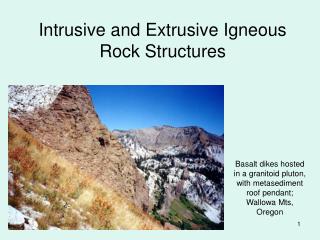
Two Major Groups of Igneous Rocks – Classified according to where the rock crystallizes • Intrusive Igneous Rocks – when the cooling of magma occurs deep below the crust. • Extrusive Igneous Rocks – when the rapid cooling of lava or melted rock occurs on the earth’s surface.
Texture – the size of the crystals in the rock. • Coarse grained – crystals can be seen with the naked eye • Fine grained – no visible crystals or the crystals are too small to be seen with the naked eye
Composition – the materials that form in igneous rocks depends on the chemical composition of the magma or lava from which the rock cools and crystallizes. • Felsic Igneous Rocks • fel = feldspar + sic = containing oxygen and silicon • Light in color • High in Silica • Main minerals are feldspar and quartz • Low Density • Mafic Igneous Rocks • Ma = magnesium + fic = ferric = iron • Dark in color • Low silica • High density