The Enlightenment
This chapter explores the pivotal ideas of influential Enlightenment figures such as John Locke, whose "Tabula Rasa" concept revolutionized the understanding of human nature. It delves into the contributions of Montesquieu, Voltaire, and Emilie du Châtelet, highlighting their roles in shaping Enlightenment thought and advocating for rational religion, especially Deism. Additionally, it addresses the perspectives of Moses Mendelssohn on Jewish culture, Diderot's editorial influence, and Rousseau's critique of society. Immanuel Kant's imperative to "dare to know" embodies the spirit of the Enlightenment.

The Enlightenment
E N D
Presentation Transcript
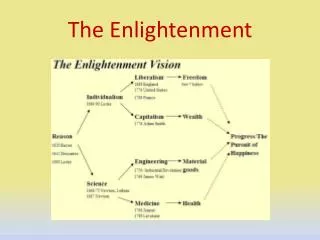
The Enlightenment Chapter 17, pp 487-494
John Locke • What were his ideas? • His most important contributions to Enlightenment were… • “Tabula Rasa” • Father of the study of
Baron de Montesquieu • Father of the study of • Universal human nature
Voltaire • Contributions to the Enlightenment… • Made it socially acceptable and laudable to attack Christianity • Deist • Beliefs of a Deist? • Religion is a matter of individual conscience….
Emilie du Chatlet • Author of _______________ • Associated with ____________ • Contributions to the Enlightenment…
Enlightenment Religion Deism Matierialism Definition: Adherents: Logical Extension of Enlightenment thinking: Definition: Adherents: Logical Extension of Enlightenment thinking:
Moses Mendelssohn • Jewish • Believed that the Jewish faith can be proven by reason – remove the supernatural and the miraculous • Rejected Jewish uniqueness “Chosen People” • Jews should be open to larger European culture
Diderot • Editor of • Important contributions… • Who contributed to his work?
Jean-Jacques Rousseau • Rejected • Human beings are corrupted by • The general will vs. individual rights
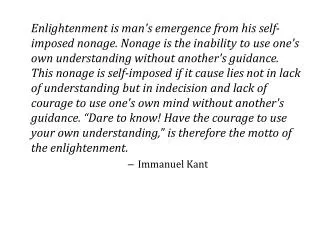
Immanuel Kant • “Dare to know…Have the courage to use your own understanding…the motto of the Enlightenment.” (What Is Enlightenment?, 1784) • In what way was knowledge to be used, according to Kant?