Download
1 / 15
150 likes | 279 Views
In this lesson, we explore the innate immune response's limitations in controlling infections and the subsequent activation of adaptive immunity. We'll discuss the roles of B and T lymphocytes, how they recognize antigens, and the process of clonal expansion that allows for a tailored immune response. By understanding the differences in how B and T cells respond to antigens—both extracellular and intracellular—we gain insight into the complexities of the immune system. Students will engage in discussions and a brainstorm exercise to deepen their understanding.

E N D
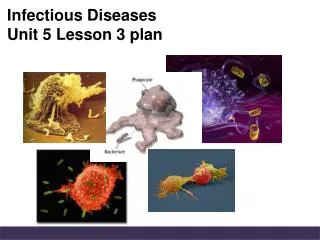
Infectious Diseases • Unit 5 Lesson 3 plan
Do now • Why might the innate response be unable to control an infection? • What happens then?
Do now • Why might the innate response be unable to control an infection? • What happens then? • What is ADAPTIVE IMMUNITY?
Do now • What is adaptive immunity? • What happens when innate responses don’t control the infection?
Adaptive immune cells are called • Lymphocytes. B lymphocytes are made in the blood • Secrete antibodies T lymphocytes are made in the thymus • Some help activate immune system responses. • Others attack and kill cells infected with bacteria or viruses.
Adaptive cells ‘see’ Antigens • Antigens are: • Not usually found in the host – they are specific to the pathogen. • They are recognized by a specificreceptors on B and T cells. The T cell receptor binds antigen that is presented by an innate cell The B cell receptor can be attached to the cell surface … ….or released from the cell surface as an antibody.
Small group brainstorming: • At your table, take 10 minutes to complete the worksheet.
Each B and T cell responds to onlyone antigen • There are millions of kinds of B cells and T cells • Each randomly makes one antigen receptor. • They wait in the lymphatic system. • If they ‘see’ their antigen theywill respond. Antigen Only the B cells that ‘see’ their antigen respond!
How do B cells recognize ‘their’ antigen? • B cells bind to extracellular antigen. • They cannot ‘see’ anantigen that is inside cells!
How do T cells recognize ‘their’ antigen? • T cells only bind to antigen when it is presented to them by an antigen presenting host cell • T cells can ‘see’ both extracellular and intracellular antigens! Extracellular antigen (bacterial infection)
How do T cells recognize ‘their’ antigen? • T cells only bind to antigen when it is presented to them by an antigen presenting host cell • T cells can ‘see’ both extracellular and intracellular antigens! Intracellular antigen (viral infection!)
At your table, discuss thefollowing question: • Each B and T cell receptor is unique because it was made randomly. • So, if only one B cell has a receptor that recognizes H1N1, how could this lone cell control the infection?
Clonal expansion As soon as B and T cells bind an antigen they begin to replicate – this is called clonal expansion! 2. Bind to a specific antigen 1. B cells with antigen receptors 3. Then begin to replicate – clonal expansion increases the pool of B cells available. Remember, only the antigen specific cells respond. This creates a pool of adaptive recognition specialists!
Homework • Write one paragraph that summarizes the main points of today’s lesson.