Exploring Scientific Skills: Observation, Inference, and Prediction
This guide delves into the essential skills of science, emphasizing observation, inference, and prediction. Observations involve collecting information through senses, while inferences are conclusions drawn from these observations. Predicting future events relies on current evidence and past experiences. Additionally, the classification of items based on shared characteristics and the creation of models facilitate a better understanding of complex phenomena. Effective communication is crucial for sharing ideas and findings. Discover how these skills enhance our comprehension of the natural world.

Exploring Scientific Skills: Observation, Inference, and Prediction
E N D
Presentation Transcript
SCIENCE • A way of learning about the natural world and the knowledge gained through the process.
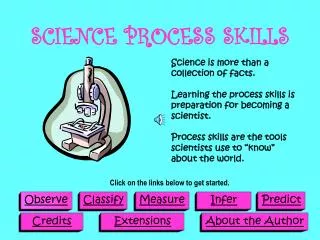
Observations • Any information collected with the senses. • The skill of describing scientific events. • Ex – hearing a dog bark, counting twelve green seeds, and smelling smoke.
Inference • Conclusions or deductions based on observations . • The process of drawing a conclusion from given evidence.
Predicting • Involves making an inference about a future event based on current evidence or past experience. • Weather forecasters makepredictions of the next day’s weather based on what has happened in the past.
Classifying • The grouping together of items that are alike in some way. • You can classify by size, shape, use, and other characteristics.
Making Models Models are pictures, diagrams, computer images, or other representations of a complex object or process. This helps people understand things that they cannot directly observe.
Communicating The process of sharing ideas or information with other people. It requires many skills, including writing, reading, speaking, and listening.
Tracks like these are common in parts of New England and in the southwestern United States. What do you OBSERVE? What can you INFER?
Source of graphic:http://bob.nap.edu/html/evolution98/evol6-e.html