Download
1 / 1
10 likes | 130 Views
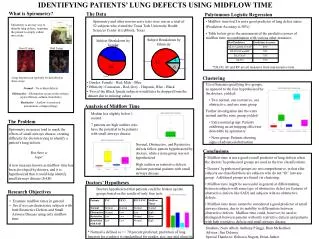
This study examines the effectiveness of midflow time as a predictor for identifying lung defects, particularly in patients with small airways disease (SAD). Conducted at Texas Tech University Health Sciences Center with 52 subjects, the analysis highlights challenges in classifying lung defects through traditional methods. Although midflow time shows limited predictive accuracy (50%), it may help differentiate obstructive and restrictive defects. Additional clustering methods identified groups not defined by existing hypothetheses. The research serves as a critical step in enhancing diagnostic strategies for lung diseases.

E N D
IDENTIFYING PATIENTS’ LUNG DEFECTS USING MIDFLOW TIME • Median lies slightly below 1 second • 7 patients are high outliers who have the potential to be patients with small airways disease 22 30 4 42 6 Normal, Obstructive, and Restrictive defects follow pattern hypothesized by doctors, while a none group was not hypothesized High outliers in restrictive defects indicate potential patients with small airways disease What is Spirometry? The Data Polytomous Logistic Regression Spirometry and other non-invasive tests were run on a total of 52 subjects who visited the Texas Tech University Health Sciences Center in Lubbock, Texas • Midflow time itself is not a good predictor of lung defect status (Prediction Accuracy is 50%) • Table below gives the assessment of the predictive power of midflow time in combination with various other measures Spirometry is an easy way to identify lung defects, requiring the patient to simply exhale into a tube Subject Breakdown by Ethnicity Subject Breakdown by Gender Good Lungs Bad Lungs *DLCO, AV and RV are all measures from non-invasive tests Clustering Lung function can typically be described in three ways: • Gender: Female - Red, Male - Blue • Ethnicity: Caucasian - Red, Grey - Hispanic, Blue - Black • Two of the Black female subjects would later be dropped from the • dataset due to missing values • Use of kmeans specifying five groups, as opposed to the four hypothesized by the doctors, yielded: • Two normal, one restrictive, one obstructive, and one none group • Further investigation into the extra normal and the none group yielded: • Extra normal group: Patients exhibiting an air trapping effect not detectable by spirometry • None group: Patients showing signs of advanced obstruction Normal – No evident defects Obstructive – Obstruction occurs in the airways (cystic fibrosis, asthma, bronchitis) Restrictive – Airflow is restricted (pneumonia, collapsed lung) Analysis of Midflow Time The Problem Spirometry measures tend to mask the effects of small airways disease, creating difficulty for doctors trying to identify a patient’s lung defects. Conclusions But there is hope! • Midflow time is not a good overall predictor of lung defects when the doctors’ hypothesized groups are used as the true classifications. • Doctors’ hypothesized groups are not comprehensive, in that after subjects are classified there are subjects who do not “fit” into any group. Additional groups are found via clustering. • Midflow time might be successful in general at differentiating between subjects with some type of obstructive defect (or features of obstructive defects like SAD) and subjects with no obstructive defects. • Midflow time alone cannot be considered a good predictor of small airways disease, due to its inability to differentiate between obstructive defects. Midflow time could, however, be used to distinguish between patients with only restrictive defects and patients with both restrictive defects and small airways disease. A new measure known as midflow time has been developed by doctors, and it is hypothesized that it could help identify small airways disease (SAD) Doctors’ Hypotheses Doctors hypothesized that patients could be broken up into groups based on the results of only four tests Research Objectives • Examine midflow times in general • See if we can characterize subjects with both Restrictive Defects and Small Airways Disease using only midflow time Students: Nora Albert, Anthony Pileggi, Rion McKeithen Advisor: Jim Delaney Special Thanks to: Rebecca Nugent, Brian Junker * Normal is defined as >= 70 percent predicted; prediction of lung function for a subject is standardized for gender, size, age and ethnicity