Download
1 / 12
120 likes | 239 Views
This study investigates the effects of tree density and height on the flagging phenomenon observed in Lodgepole Pines within Niwot's sub-alpine forest. Flagging is mainly influenced by wind, leading to varying heights of bare trunks and branches. Our hypothesis suggests that the height of bare trunks increases with both tree height and density due to reduced sunlight penetration. Using a 10x10 m transect, we measured tree characteristics and analyzed their relationships. The findings underscore the importance of these factors for forestry practices and habitat management in the face of climate change.

E N D
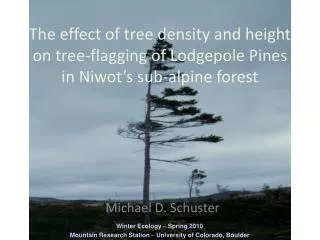
The effect of tree density and height on tree-flagging of Lodgepole Pines in Niwot’s sub-alpine forest Michael D. Schuster Winter Ecology – Spring 2010 Mountain Research Station – University of Colorado, Boulder
Mechanisms of tree flagging • Predominately carried out by wind • Krummholz: “Crooked Wood” in German; These are the type of trees/shrubs near or at treeline • Reasons for bareness of trunk: lack of SR
In the Big Picture • Why is this important? • Useful for forestry practices • Can put in context of CC scenario • Affects passage of mammals
Observations and Hypothesis • I noticed that the trees had varying heights of bare trunk and branches, and this general height changed when the trees were either taller or closer together • Hypothesis: affected by amount of sun reaching lower branches, not by krummholz or wind as much • As the avg height increases, the height of the bare tree will also increase • As the L.P. Pine density increases, the height of bare tree should also increase (more trees-more coverage-less sun to ground)
Methods • 10x10 m transect • Clinometer, field tape, flags, snow probe • Total density, density of conifers • Avg height (clinometer), snow depth
Conclusions • Total L.P. Pine height increases with elevation • Bare trunk height is variable—other factors • Density increases with elevation • % of bare trunk increases with increase in total height • No significant results—other variables are affecting the outcome
Other variables to consider • Slope of transect • Aspect of transect (tried to keep this constant) • Elevation • Type of forest (are there deciduous trees) • Amount of exposure (wind • Snow depth (how does this affect height of bare tree) • Inaccuracies with measurements (10 m distance of transect, from tree, density average)
Suggestions for next time • Bring an altimeter, measure elevation • More accurate measurments of snow depth • Find a better way to measure density • Choose transects carefully, controlling for: • Slope, aspect, exposure, types of trees (no deciduous) Finally, for next time: BRING A CAMERA
Works Cited • Reference articles Arno, Steven F. Timberline: Mountain and Arctic Forest Frontiers. Chp.1 excerpt, prepared by CU. New York, 2007. • Pictures: • http://www.daviddarling.info/images/vegetation_flagging.gif • http://www2.swgc.mun.ca/botany/burntisland/images/Flagging%201.jpg