Understanding and Using MLA Citations: A Guide for Students
140 likes | 254 Views
This guide outlines the importance and methodology of creating MLA citations for academic writing. It emphasizes the significance of proper citation to avoid plagiarism and enhance credibility. Students will learn how to effectively write and edit their work in compliance with style manual guidelines. The guide includes practical exercises to help students practice their citation skills using real examples and emphasizes the necessity of sourcing and properly attributing information used in their papers.


Understanding and Using MLA Citations: A Guide for Students
E N D
Presentation Transcript
MLA Works Cited Ms. Hopkins 12 Sept. 2012
Standard of the Day • ELACC9-10L3: Apply knowledge of language to understand how language functions in different contexts, to make effective choices for meaning or style, and to comprehend more fully when reading or listening. • a. Write and edit work so that it conforms to the guidelines in a style manual (e.g., MLA Handbook, Turabian's Manual for Writers) appropriate for the discipline and writing type. • Create your own I CAN for standard ELACC9-10L3 using the following CLOZE: • I Can _________ knowledge of language to understand how language ___________ in different __________, to make __________ choices for meaning or style. • I can write and edit work so that it meets the ________________ in a style manual _______________ for the discipline.
Essential Questions • Why must all sources used in the research process be properly cited? • What is plagiarism, and how can it be avoided?
Why do we use citations? • When consulting any kind of outside information when writing, it is important to cite your sources. • This allows for the reader to also locate the information and resources you used in your paper. • Citations give you credibility as a writer. • Citations also prevent you from plagiarism.
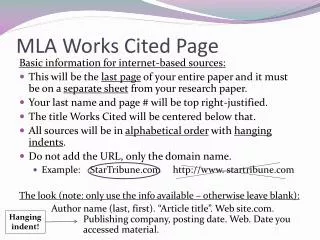
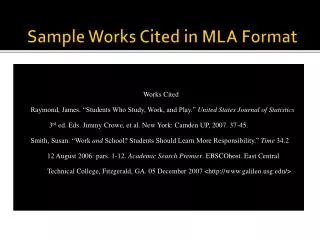
Works Cited • A works cited page is a list of all the sources that were used or reviewed in order to write your paper. • This page should be titled “Works Cited” and be centered on the page. • The sources are listed in alphabetical order by author’s last name. • If a citation is longer than one line, the remaining lines are indented—hanging indention.
Information Needed to Write a Citation: • Citations vary depending on what type of source you are using. Most citations will need the following information: • Author • Title • Publisher • Place of Publication • Publication Date • Medium of Publication
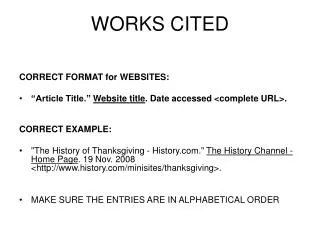
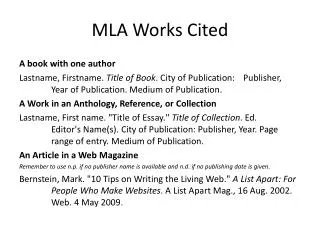
A Book by a Single Author • Author’s last name, first name. Title of the Book. City of publication: Name of Publisher, Year. Medium of publication. • Lore, Pittacus. The Rise of Nine. New York: HarperCollins, 2012. Print.
For practice with writing MLA citations-- • Turn to the next two clean pages in your sourcebook. Write “MLA practice” on the input side. • You have 60 seconds to get in groups of two.
Practice One: • Put the pieces of the cut citation in order.
Answer to Practice One: • Anderson, Curtis. The Long Tail: Why the Future of Business Is Selling Less of More. New York: Hyperion, 2006. Print.
Practice Two: • Using the following information, create a citation for a book with a single author. • Author’s Name: Veronica Roth • Title of Book: Insurgent • Publisher: HarperCollins • Year of Publication: 2012 • City of Publication: New York • Medium of Publication: Print
Answer to Practice Two: • Roth, Veronica. Insurgent. New York: HarperCollins, 2012. Print.
Practice Three: • Using the novel that was placed underneath your desk, locate the information needed and write a citation for the book with a single author.
Answer to Practice Three: • Myers, Walter Dean. Monster. New York: HarperCollins, 1999. Print.