Understanding the Scientific Method: A Step-by-Step Guide
This comprehensive guide outlines the steps of the scientific method, which includes stating a problem, forming a testable hypothesis, conducting experiments, analyzing results, drawing conclusions, and communicating findings. Each step is broken down with examples, such as asking "Who has the best hamburger?" while emphasizing the importance of using control and experimental groups. Learn how to define variables, differentiate between independent and dependent variables, and effectively document and share your results.

Understanding the Scientific Method: A Step-by-Step Guide
E N D
Presentation Transcript
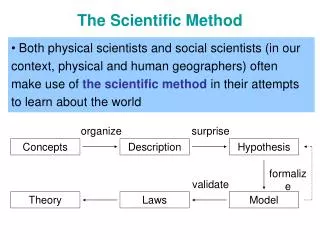
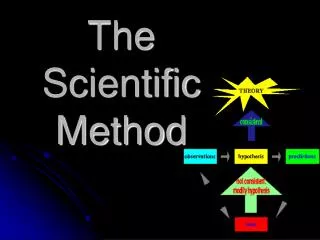
Steps in the Scientific Method • State the problem • Form a hypothesis • Test the hypothesis • Analyze your results • Draw a conclusion • Communicate your results
Step # 1State the Problem • “Who has the best hamburger?” • Always stated as a question
Make Observations • Gather Information
Step # 2 Form a Hypothesis • Hypothesis: a statement that predicts or suggests an answer to a question. • A hypothesis must be TESTABLE.
Step #3 Test the Hypothesis(Conduct an Experiment) • Experiment: a series of carefully planned steps that tests a hypothesis.
Record your findings • Write it down • make tables • create charts
Step #4Analyze the results • Analyzing helps to construct reasonable explanations based on the evidence that you have collected.
Redo your work • Why?
Step #5Draw a Conclusion • Did you prove your hypothesis?
Step # 6Communicate Results • Write a report • Give a talk • Put results on the Internet
Controlled Experiment • Uses a control group andone or more experimental groups.
What is a “factor”? • A factor is any part of an experiment.
A Definition • Control: a part of the experiment that is not being tested and is used for comparison.
A Definition • Constant: a factor that does not change during an experiment.
Variable: anything that can change in an experiment. • You must NAME the variable in your experiment.
Independent Variable • The part of the experiment that is changed by the person doing the experiment.
Dependent Variable • The part of the experiment that is affected by the independent variable.
The Groups: (1) control group & (2) experimental group • All “factors” are the same for both groups except for ONE. • This factor is called the “variable”. • It is the thing being tested. • The experimental group has the “variable”.