Understanding the Chemistry of Life: Basics of Cells, Atoms, and Organic Compounds
This comprehensive review delves into fundamental concepts of chemistry that underpin life, focusing on the structure of atoms, the role of elements, and the formation of compounds. It covers key aspects like atomic structure, types of chemical bonds (ionic, covalent, and hydrogen), and the significance of water in biological systems. Additionally, the importance of organic compounds, including nucleic acids and ATP, is discussed, revealing how these components support cellular functions. Gain insights into the molecular foundations that sustain life.

Understanding the Chemistry of Life: Basics of Cells, Atoms, and Organic Compounds
E N D
Presentation Transcript
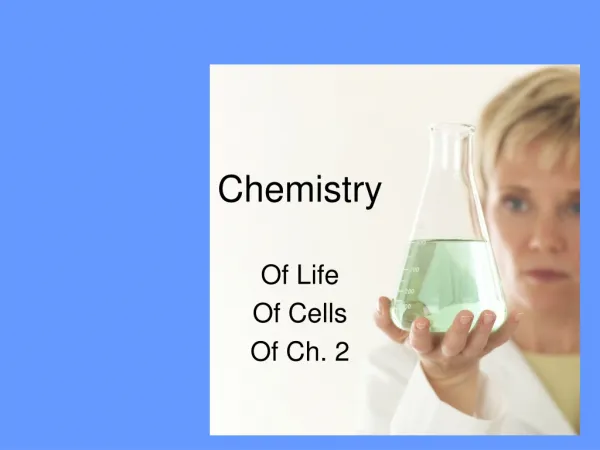
Chemistry Of Life Of Cells Of Ch. 2
Di = Two Glyc = Sweet Mono = One Lip = Fat Lyt = dissolvable Poly = Many Sacchar = sugar Syn= together Prefix and Suffix List
Chemistry Review - Elements • Pure substance made up of only one kind of atom • 90 occur naturally • 25 essential to life: O, C, H, N • 0= 65%, C=18.5%, H=9.5%, N=3.2% • Atom: smallest unit of matter that cannot be broken down by chemical means.
Chemistry Review Atoms • Three major parts. (Pg24) • Protons:Positive Charge. Inside Nucleus • Neutrons: Neutral Charge. Inside Nucleus: • Electrons: Negative Charge. Outside Nucleus • 2 electrons in first shell • 8 electrons in the second shell • Eight is Great! Will not React with other atoms. • If the outer shell is not full it will react.
Models of atom showing location of protons, neutrons, and electrons
Periodic Table Bonding Combining Chemicals • Compound: When two or more different elements combine. • Hydrogen Bond: H2O • When hydrogen bonds with a highly electronegative atom (O or N). Creates a polar molecule. • Covalent bond: CO2 • When atoms on the same side of the chart (same size) bond. Share electrons. • Can be polar or nonpolar • Both Hydrogen and Covalent bonds form molecules, ionic bonds do not. Ionic/ Covalent Bonds
Combining Chemicals continued • Ionic Bonds: When atoms on different sides of the chart (different size) bond. Steal electrons. Create Ions • Ion: Charged particle either negative or positive. • NaCl = table salt
Checkpoint • What are the meanings of atomic number, mass number, ion and molecule? • What is the significance of the valence (outer) shell of an atom? • Distinguish among ionic, covalent, and hydrogen bonding.
Solution • A mixture in which one or more substances are evenly distributed in another substance. • Solute: smaller word, smaller thing • Solvent: bigger word, bigger thing
The Importance of Water • Polar molecule (it has a negative and positive charge.) • Can dissolve both Ionic and Polar-Covalent molecules • Surface Tension • Cohesion: Sticks to itself. • Adhesion: Like a band-aid. Sticks to stuff • Capillary Action: Climbs up thin tubes
Organic Compounds:All organic compounds contain Carbon. • Nucleic Acids: pg. 39 DNA and RNA • Made of nucleotides: Sugar, Phosphate, and a Nitrogen Base. A::T, C:::G, U • ATP: energy cells run on.
DNA Molecule DNA: Go to Problem
ATP Molecule ATP Explained