Photosynthesis
120 likes | 246 Views
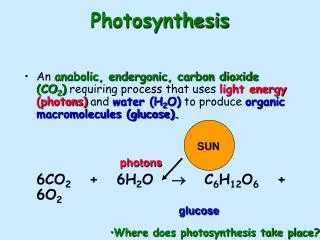
This overview explores the essential process of photosynthesis, detailing the roles of chlorophyll and pigments in light absorption. Chlorophyll absorbs red and blue light while reflecting green, whereas carotene, xanthophyll, and anthocyanin provide color diversity. The two main reactions are the light reaction, occurring in the thylakoids and generating oxygen and ATP, and the light-independent reaction (Calvin Cycle), taking place in the stroma to convert CO2 into glucose. These processes reveal how plants produce energy and contribute to human society.


Photosynthesis
E N D
Presentation Transcript
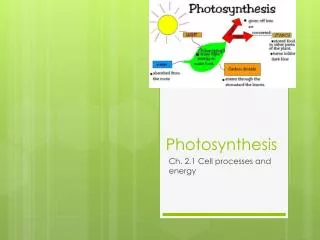
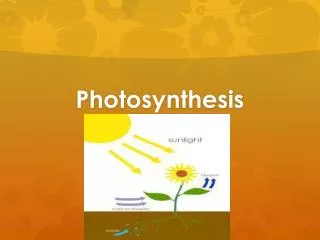
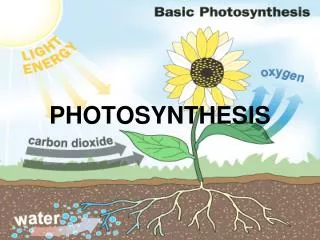
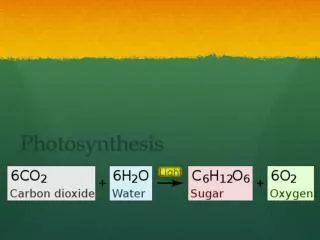
Basic Photosynthesis Write an equation with all the words in this picture.
Chlorophyll Pigments that absorbs light. Also… Carotene (orange) Xanthophyll (yellow) Anthocyanin (blue/purple)
Chlorophyll absorbs red and blue light, while reflecting green
Chlorophyll a vs. b They complement each other. Shade of green is dependent on ratio of a to b.
Two Reactions • Light Reaction • Dark Reaction • Also known as Light Independent Reaction • Also known as the Calvin Cycle
Light Reaction • Occurs in the granum (on the thylakoid (in the lumen (where chlorophyll is))). • Light splits water to make oxygen, a proton, and ATP. • Equation: 12H2O + 12NADP + 18ADP → 6O2 + 12NADPH + 18ATP
Light Independent Reaction • Occurs in stroma • ATP and H+ are used to turn CO2 into glucose. • Equation: ATP + NADPH + CO2 C6H12O6 + ADP + NADP
Starch • Glucose is stored as starch (carbohydrate) • Examples of starch include:
“Every violation of truth is not only a sort of suicide in the liar, but is a stab at the health of human society.” Ralph Waldo Emerson (1803-1882)