Understanding Urinary System Functions: Excretion, Metabolic Wastes, and Homeostatic Regulation
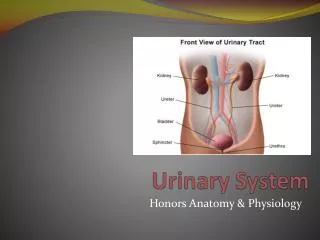
Explore the intricate workings of the urinary system, including excretion of metabolic wastes (urea, creatinine, uric acid), kidney regions, mechanisms of filtration, reabsorption, secretion, and urine concentration regulation.

Understanding Urinary System Functions: Excretion, Metabolic Wastes, and Homeostatic Regulation
E N D
Presentation Transcript
Functions 1. Excretion • Elimination • Homeostatic Regulation
Metabolic Wastes • Urea • Creatinine • Uric Acid
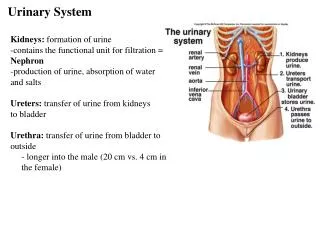
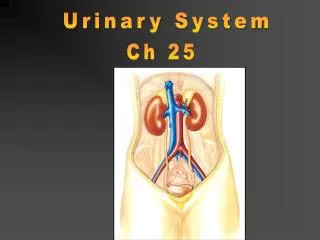
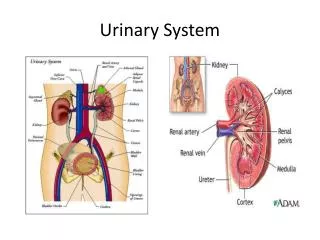
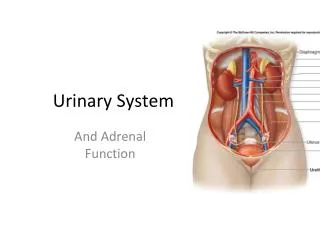
Urinary System • Kidney regions: • Cortex • Direct filtration • cortical nephrons • juxtamedullarynephrons 2. Medulla • Reabsorption, Secretion • Pelvis excretion
Overview of Urinary System • Flow • Filtration • Reabsorption • Secretion
Glomerular Filtration • Filtration membrane • Net Filtration Pressure: • Glomerular hydrostatic pressure (HPg) (GBHB) • Colloid osmotic pressure (OPg) (BCOP) • Capsular hydrostatic presure (HPg) (CHP) • Glomerular Filtration Rate (GFR)
Tubular Reabsorption • Reabsorption of organic nutrients • Reabsorption of ions, water, and some molecules. • Water reabsorption- osmotic changes due to active transport of sodium ions. • Molecule reabsorption - secondary active transport initiated by ions. Types of Active Transport • Co-transport • Countertransport
Types of carrier mediated transport • Facilitated diffusion • Active Transport (secondary active) • Cotransport(symport) • Countertransport(antiport)
Tubular Secretion • Disposes of unwanted solutes • Regulation of Urine Concentration and Volume • countercurrent mechanism • osmotic gradients • Diuretics
Maintaining Homeostasis Balances: Water/salt pH Blood pressure