Integrating Biophysical, Economic, and Policy Analyses for Effective GHG Mitigation Programs
This workshop explores how to create cohesive mitigation programs that integrate biophysical, economic, and policy perspectives. Led by Steven Rose (USEPA) and Bob MacGregor (Agriculture and Agri-Food Canada), discussions focus on addressing the gaps in current analyses which are often discipline- and site-specific. Through case studies in the Canadian Prairies, U.S. Corn Belt, and Mississippi Alluvial Valley, the goal is to evaluate mitigation potential while identifying limitations and opportunities for improving program implementation. Practical guidance will be provided to presenters on defining program scenarios, assessing mitigation activities, and understanding stakeholder responses.

Integrating Biophysical, Economic, and Policy Analyses for Effective GHG Mitigation Programs
E N D
Presentation Transcript
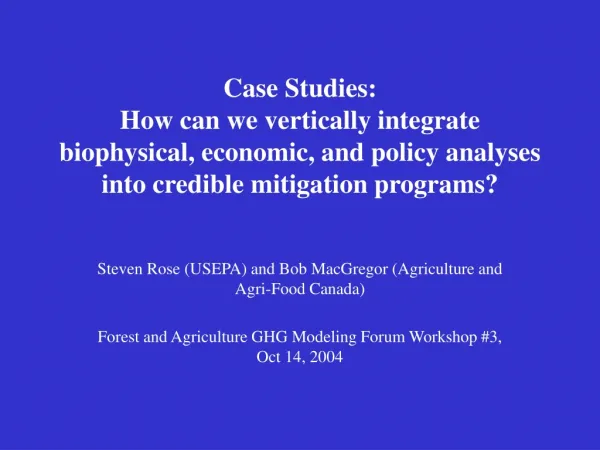
Case Studies: How can we vertically integrate biophysical, economic, and policy analyses into credible mitigation programs? Steven Rose (USEPA) and Bob MacGregor (Agriculture and Agri-Food Canada) Forest and Agriculture GHG Modeling Forum Workshop #3, Oct 14, 2004
Motivation & Strategy • Motivation: lacking cohesive picture of how sinks activities might be included in registries or emission trading regimes or other policy tools • Currently discipline- and site-specific analyses • Strategy: assemble a vision of how mitigation might work by integrating different perspectives with respect to a location and activity to understand how stakeholders are going to respond
Case Studies • Three case studies--region/primary mitigation activity • Canadian Prairies/Soil Carbon Management • U.S. Corn Belt/Soil Carbon Management • U.S. Mississippi Alluvial Valley/Afforestation • Three perspectives: biophysical, economic, and land owner/implementation
Case Study Goals • Evaluate technical, economic, and implementation mitigation potential • Identify current analytical alternatives and limitations for characterizing mitigation activity • Identify research and data gaps and opportunities for improving our understanding and project/program implementation
Guidance to Presenters • Define program & project scenario, specifying 2015 mitigation target, location/location type, and mitigation strategy • Panels may assess other feasible mitigation activities • Apply existing work--ad hoc characterization • Try to address: • What mitigation practices seem promising • GHG effects • Economic costs--direct, opportunity costs • Implementation issues: baselines, measurement, monitoring, uncertainty, permanence, leakage, transaction costs, environmental co-effects, aggregation and contractual issues, payment approaches • Landowner participation perspective