Download
1 / 9
90 likes | 193 Views
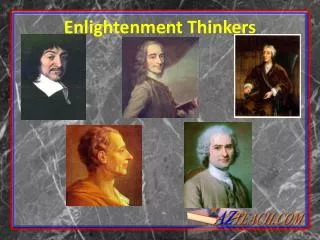
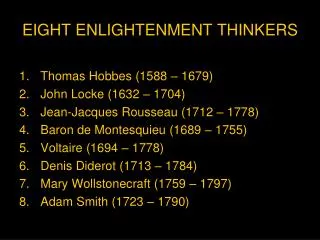
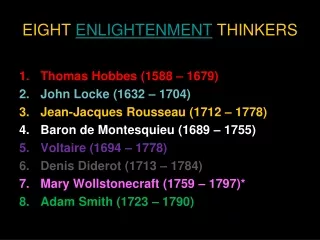
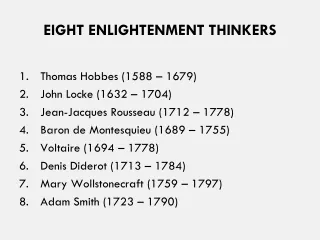
This overview explores key Enlightenment thinkers and their influential concepts regarding government, social contracts, and natural rights. John Locke emphasized the importance of property in natural rights and advocated for the right to revolution. Montesquieu proposed safeguards against government corruption. Feminist philosophers like Mary Astell and Mary Wollstonecraft advocated for women's education and rights. Voltaire championed deism, while Thomas Hobbes analyzed the human condition and the necessity of a stable political order. Together, these ideas laid the foundation for modern democratic thought.

E N D
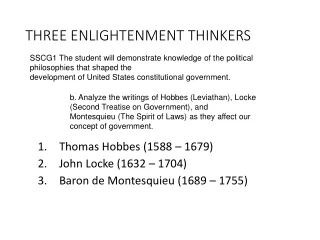
3 concepts of gov’t: Consent of the goverened a social contract between a fair gov’t & responsible citizens right to revolution Locke believed Property was the most impt. of his natural rights! John Locke
Friedrich Melchior • Key figure in spread of enlightenment ideas - French • Wrote a cultural newsletter, edited for the benefit of foreign sovereigns and nobility
French College educated - lawyer Political Philosopher Explained how government can be preserved from corruption Montesquieu
Jean Jacques Rousseau • one of the most influential books of republican thought • proposed a form of contract that should grant people liberty
Mary Astell • Not born into wealth/nobility • Considered the first feminist philosopher • Supported education of women
Mary Wollstonecraft • British • Feminist writer • Established a girls school in Newington Green • Contributed to the publication Analytical Review • “society breeds ‘gentle domestic brutes’, a confined existence makes women frustrated and transforms them into tyrants over their children and servants”
Voltaire • French Philosopher • Exiled three times • He argued in favor of "deism”
Thomas Hobbes • English Political Philosopher • main concern is the problem of social and political order: how human beings can live together in peace and avoid the danger and fear of civil conflict • “state of nature” that closely resembles civil war – a situation of universal insecurity, where all have reason to fear violent death and where rewarding human cooperation is all but impossible.