Advances in Polymer Film Technologies: Exploring Various Anchoring Techniques and Applications
190 likes | 303 Views
This document presents a comprehensive overview of innovative polymer film technologies, focusing on different anchoring techniques such as parallel, perpendicular, radial, and bipolar configurations. It examines the processes involved in the fabrication of films, including sonication, etching, and deposition on substrates like PET. Through a series of figures, we illustrate the behavior of polymer solutions and films under strain and their potential applications in advanced optics and materials science. The findings contribute to the understanding of film properties under various conditions.


Advances in Polymer Film Technologies: Exploring Various Anchoring Techniques and Applications
E N D
Presentation Transcript
Parallel anchoringPerpendicular anchoring radial axial bipolar bipolar E E torroidal bipolar axial axial E E Figure 2
ER ERPD PR PP Figure 8
(a) (b) (c) Template Capillary Filled Polymerizing (f) (d) Sonication (g) (e) Separated Before Sonication Etching Figure 9
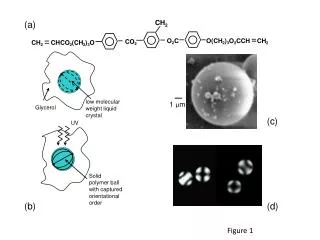
(a) (b) (c) (d) Figure 10
1 PVA/H2O/LC Solution LC PET Substrate Meyer Rod Deposition PVA H20 H2O Evaporates 2 PET Substrate Evaporate off H20 LC 3 PVA Release PET Substrate Release Film from PET Figure 16
4 Minimat Free Standing PVA/LC Film 5 Prototype films Apply Tensile Strain (>100%) 6 Thin Film Scattering Polarizer Figure 17
stretch axis Transmission axis of conventional polarizer Figure 18
1mm 500 nm 10mm 10mm 10mm 10mm Uniaxial 50 % Uniaxial 100 % Biaxial 100 % Uniaxial 200 % Biaxial 100 % Uniaxial 400 % Figure 19