Download
1 / 25
250 likes | 324 Views
Explore current trends in physician compensation, various payment models, and the factors affecting pay structures. Learn how to optimize compensation plans for healthcare professionals.

E N D
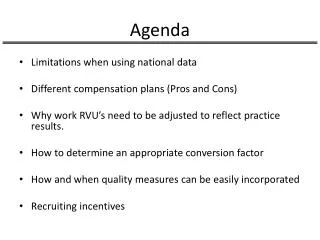
Agenda • Limitations when using national data • Different compensation plans (Pros and Cons) • Why work RVU’s need to be adjusted to reflect practice results. • How to determine an appropriate conversion factor • How and when quality measures can be easily incorporated • Recruiting incentives
Why are hospitals employing physicians? • Declining Reimbursements • Health System Consolidation • Meaningful Use • Medical School Debt • Work Life Balance • Vacation, Benefits & Retirement Savings
Sources of Physician Compensation • Medical Group Management Association • Physician and Production Survey • Cost Survey • American Medical Group Association • Sullivan Cotter • The Advisory Board • Other Surveys
Using MGMA data • PROS • The information reported is generally accepted across the medical industry • wRVU values are consistent across the nation • Able to provide historical comparisons over many years (founded in 1926, changed name to MGMA in 1963) • CONS • Compensation data does not include regional fluctuations • Relatively small sample sizes • Generally assumed, you only get “the best of the best” to participate in the survey • Data gathered is subject to the interpretation of the individual providing the information
MGMA – Employed Physicians 47% • Production Survey • Reports on charges, collections, compensation • Published in November using survey results from the previous year • 2011 report, 59,375 providers reported, 2,562 from Ohio, or 4.31% • Cost Survey • Provides a “mini-income statement” for many common specialties • Published in November using previous year’s data • 2011 report, 1,633 practices reported, 33 from Ohio, or 2.02% 24% Source: MGMA 2003 – 2011, Physician Compensation and Production Survey
MGMA Survey Demographics Ohio = 4.3% Source: MGMA 2011, Physician Compensation and Production Survey
Straight Salary • Generally reserved for new graduates • Start-up markets or practices • Medical Education (Academic Institutes) • Pros - • Easier to recruit physicians – guaranteed compensation • Protects physicians from poor payer mix • Cons- • No production incentive • Lacks expense control incentives • No organizational alignment
Net Income Model • Revenue Less Expenses • Generally reserved for established physicians • Pros - • Production incentive • Incentivizes physicians to maintain expenses • Cons - • Harder to recruit physicians – at risk • Penalizes providers for poor payer mix • Lacks organizational alignment
Net Income Model (+ market adjustment) • Credit Revenue • Payer mix credit • Reimbursement credit • Pros - • Production incentive • Incentivizes physicians to maintain expenses • Protects physicians from payer mix • Protects physicians from poor reimbursement • Cons - • Complicated to calculate – numerous iterations of financial modeling to determine market adjustment factor
Production Incentives - wRVU • Generally reserved for established practices • Increasing in popularity • Pros - • Production incentive for physicians • Protection from poor payer mix • Cons - • Does not incentivize physicians to manage expenses • Penalizes providers for poor payer mix • Lacks organizational alignment
Medicare C/F History 2000-2012 • Medicare conversion factor (CF) has decreased by 7% since 2000
GPCI and Medicare’s Allowable Amount Practice Expense GPCI Medicare’s Allowable (2011) – 99213 47% 50% 3% wRVU (.97) X GPCI (.998) PE (1.03) X GPCI (.927) MP (.05) X GPCI (1.24) $68.28 $36.8729
Adjusting wRVU Production • Potential overpayment to physicians • Necessary adjustments to wRVUs • Charge Entry Errors • Denial Adjustments • Global Services • Not Medically Necessary
Quality Metrics • 62% of MGMA physicians include incentive based compensation plans tied to quality metrics • Physician comp plans include between 1% and 10% at risk for quality measures (2011, Merritt Hawkins)update
Recruiting Trends • Primary care remains top priority for past 7 years • Psychiatrist are 3rd on the list • General Surgeons are 5th on the list Source: Merritt Hawkins. 2012 Review of Physician Recruiting Incentives
Compensation Trends • 7% of placements featured income guarantees • Down from 21% in 2006/2007 • 75% of placement featured salary with production bonus • 54% of those based on wRVUs • 35% include quality based component • Up from 7% the previous year • Signing bonus and relocations remain standard Source: Merritt Hawkins. 2012 Review of Physician Recruiting Incentives
Guidelines – Developing a Comp Model • Keep it simple (back of the napkin) • Compensation model must be objective • Consider hospital and physician alignment • Include quality incentives • Patient Satisfaction • Peer Reviews • Quality Outcome
Implementation • Physician buy-in is essential to developing a successful compensation model • Create a compensation committee that includes cross-specialty physicians and hospital administration • Create shadow compensation reports. (3-6 months prior to implementation) • Implement quality metrics percentage slowly. • Year 1 =5% of total comp • Year 2 = 10% of total comp
Questions / Comments Thank You