Download
1 / 12
130 likes | 177 Views
Explore different narrative viewpoints in literature, including 1st, 2nd, and 3rd person perspectives, stream of consciousness, and unreliable narrators. Learn about psychic distance and its impact on storytelling.

E N D
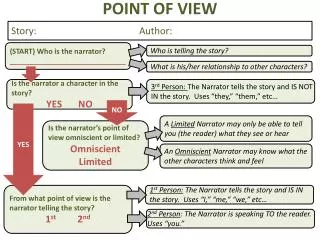
Things to consider • Participant or non-participant • Objectivity • Distance • Reliability
Participant • 1st person • Major character • Minor character • Innocent eye narrator • Stream of consciousness • Different times of a narrator’s life
Non-participant • 3rd person • Omniscient narrator • Selective (limited) omniscient • Objective narrator
Non-participant • 2nd person • Use of “you,” “your,” “yourself” • Rarely used in literature • Used to draw reader in – not to refer to reader
DistanceFrom John Gardner on Psychic Distance • It was winter of the year 1853. A large man stepped out of a doorway. • Basic situation • General details • No emotion
DistanceFrom John Gardner on Psychic Distance • Henry J. Warbuton had never much cared for snowstorms. • Specific person • Added detail • Mild emotion
DistanceFrom John Gardner on Psychic Distance • Henry hated snow storms. • Character more personal • Stronger emotion
DistanceFrom John Gardner on Psychic Distance • God, how he hated these damn snow storms! • Extreme emotion
DistanceFrom John Gardner on Psychic Distance • Snow. Under your collar, down inside your shoes, freezing and plugging up your miserable soul. • All fragments • Participles (ing) • 2nd person
Unreliable NarratorTheory and Research into Practice Michael W. Smith • Reconstruct meaning to test validity • Evaluate reliability of information source. • Too self-interested? • Not sufficiently experienced? • Not sufficiently knowledgeable? • Not sufficiently moral? • Too emotional? • Actions inconsistent with words?
Unreliable NarratorTheory and Research into Practice Michael W. Smith • Reconstruct meaning to test validity • Check the facts of the situation • Apply knowledge of the world