Advanced Computer-Aided Surgical Planning: Current Techniques and Future Developments
This overview provides insights into computer-aided surgical planning and procedures, revealing the technical fundamentals, state-of-the-art techniques, and future developments in the field. Key components include specialized software, tracking devices, and visualization systems that enhance surgical precision. Challenges such as automated image recognition and user interface improvements are also highlighted. The benefits of 3D modeling and navigation are discussed, emphasizing the need for skilled users in utilizing these technologies effectively in the operating room.

Advanced Computer-Aided Surgical Planning: Current Techniques and Future Developments
E N D
Presentation Transcript
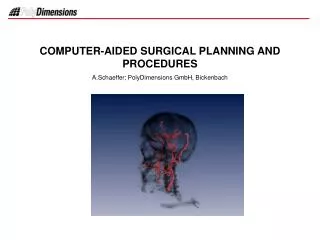
COMPUTER-AIDED SURGICAL PLANNING AND PROCEDURES A.Schaeffer; PolyDimensions GmbH, Bickenbach
Overview: • Technical fundamentals • Examples • State-of-the-Art • Problems • Results • Future developments
Technical fundamentals : Which components are used: • Computer system (mostly PC-Hardware) • Specialized software (mainly CAD-software, optimized for anatomy • Tracking devices (optical, electromagnetical, …) • Visualization systems (2D-/3D-Displays, Head-mounted-displays) • User Interaction (mouse, joystick, voice-control, gesture recognition) • Interaction with patient (microinstruments, robots…)
Examples: Planning of procedures from digital medical imaging data: • Image recognition and segmentation • Triangulation • Visualization
Generation of CAD models: © Simbionix Ltd., Israel © PolyDimensions GmbH, Bickenbach
Results: 3D models of patient anatomy for planning of surgical approach © MeVis GmbH, Bremen
Benefits: Access to computerized calculations • Estimation of size and localization • Calculation of blood supply and resection lines • 3D/Stereo-Visualization • Use for Augmented Reality
Problems and Challenges: • Automated image recognition not yet advanced enough • Time-consuming preprocessing • Computer-user-interface has to be improved for use in the OR • Skilled users are mandatory for interpretation and use of digital data
Navigation in the OR: Already in clinical use in for special procedures • Electromagnetical • Optical • Ultrasound • Others… © BrainLAB AG, Heimstetten
Benefits of navigation in the OR: • Exact localization of anatomical structures like tumors e.g. • Positioning of instruments • Use for robotic surgery • Tracking and navigation needed for Augmented Reality
Problems: • Special Precautions necessary for reliable use • Expensive • Still not usable for procedures on soft-tissue anatomy
Real-time simulation for planning and education: • Already standard in aviation industry:
Real-time simulation in medicine: • Medical education • Quality assurance © Simbionix Ltd., Israel
Visualization: • 2D-Displays • Stereo 3D-Displays • Head-Mounted-Displays © PolyDimensions GmbH, Bickenbach
Benefits and Problems: • Faster overview • Better orientation in difficult anatomy • Real-time-interaction with computer • Not yet commonly used technique • Space-consuming in the OR
Robots in the OR: Growing number of clinical use • Heart surgery • Orthopedics, Traumatology (Implantology) • Gynecology • Others… © Intuitive Surgical Inc., Sunnyvale, CA
Benefits of robots in the OR: • Precise interventions • Can perform minimal invasive surgery • Use for robotic surgery • Tracking and navigation needed for Augmented Reality
Problems: • Expensive devices • Suitable procedures must be found and surgical approach has to be optimized for robots • Force-Feedback may be helpful in robotic surgery • Extensive training and experience mandatory for use
Future developments: • Faster overview • Autonomous image recognition • Faster processing of medical data • Better navigation • Skilled and trained users