Download
1 / 5
50 likes | 184 Views
This document provides an in-depth exploration of electric power, including the power equation ( P = frac{QV}{t} ) and its various forms such as ( P = IV ), ( P = I^2R ), and ( P = frac{V^2}{R} ). It discusses power in household circuits, emphasizing the importance of amperage and voltage relationships, and delves into alternating current (AC), illustrating its characteristics with sine waveforms. Examples from the textbook enhance understanding, preparing students for upcoming homework and tests.

E N D
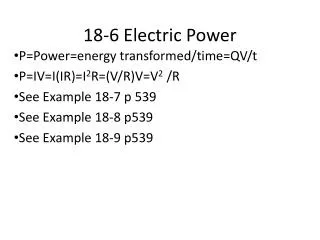
18-6 Electric Power P=Power=energy transformed/time=QV/t P=IV=I(IR)=I2R=(V/R)V=V2 /R See Example 18-7 p 539 See Example 18-8 p539 See Example 18-9 p539
18-7 Power in Household Circuits • Amperage is added in a series of household products. • Power is carried in a low amperage and high voltage because of the I2 R =IV paradox. • Voltage is constant for each appliance, but amps are summed. • See Example 18-10 p541
18-8 AC current • So far we have talked about batteries, which produce a steady flow, like a river… • AC current produces current that moves forward and then back again like the waves at a shoreline. See page 542 • AC current can be produced by an AC generator so that it has a –I and +I in a sine-wave form.
AC cont’d • I=V/R=(Vo /R)(sin2pft)=Iosin2pft • P=I2 R= I2osin22pft • Rms means root mean square…they are not really averages, but are the effective values. • Irms = See pg 543 • See example 18-11 and 18-12 p543 and 544.
HOMEWORK • P552 23-29, 33-37,40-44 , 47,51-52 DUE BOP Monday. • Test Tuesday chapter 18. • Packets due WEDNESDAY!!!!