Download
1 / 26
260 likes | 358 Views
Dive into the world of carbohydrates in biology! Learn how photosynthesis converts light energy into stored chemical energy and how carbohydrates play a vital role in providing short-term energy, structural support, and more. Explore the processes of photosynthesis and cellular respiration, understanding how these mechanisms are essential for life on Earth. Discover the intricacies of monosaccharides, disaccharides, and polysaccharides, and their significance in the production of energy. Uncover the details of cellular respiration and how ATP, the cell's energy source, is produced. Grasp the importance of aerobic and anaerobic respiration, as well as fermentation processes. Delve into the fascinating world of carbohydrates in biology and understand their crucial role in sustaining life.

E N D
Carbohydrates Honors Biology
Objectives • Use a model to illustrate how photosynthesis transforms light energy into stored chemical energy. • Construct and revise an explanation based on evidence for how carbon, hydrogen, and oxygen from sugar molecules may combine with other elements to form amino acids and/or other large carbon-based molecules. • Use a model to illustrate that cellular respiration is a chemical process whereby the bonds of food molecules and oxygen molecules are broken and the bonds in new compounds are formed resulting in a net transfer of energy.
Recall: Macromolecules • BIG biological molecules • Made of smaller parts • Monomers • Carbon-based (organic) • Carbohydrates • Nucleic acids • Proteins • Lipids
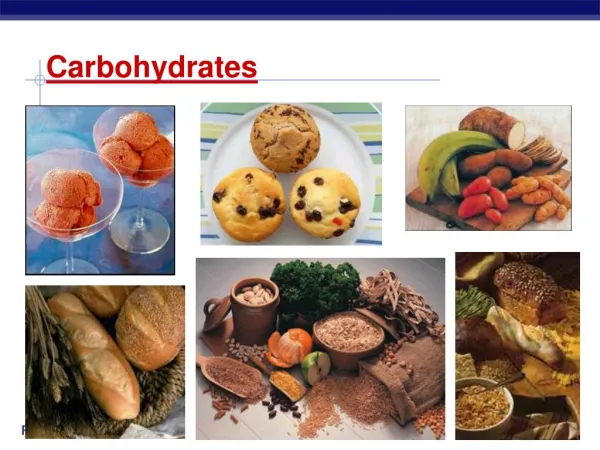
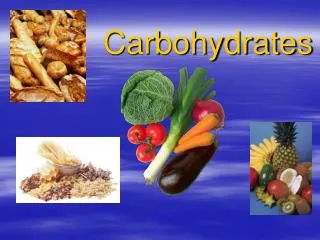
Carbohydrates • Monomer: monosaccharide • Used for: • Short term energy • Structural support • Cell tags (antennae) • Examples: • Fun fact: many carbohydrates have names that end in -ose
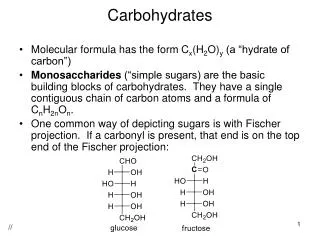
Monosaccharides • Simple (one sugar) carbohydrates • Example: glucose
Disaccharides • Simple (two sugars bonded) carbohydrates • Example: lactose
Polysaccharides • Complex (many sugars bonded) carbohydrates • Example: starch, glycogen, chitin
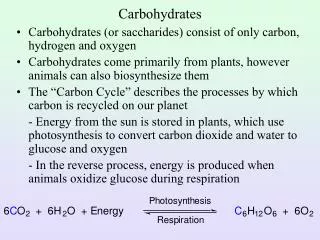
How do we get carbohydrates? • Photosynthesis • Creates glucose (C6H12O6) from CO2, H2O and sunlight Reactants Products
Why does life depend on photosynthesis? • Autotrophs are the basis of all Earth’s ecosystems • Provide food for all organisms (directly and indirectly) • Provide O2 and remove CO2 from atmosphere
How does photosynthesis happen? • The Details: • Series of 2 reactions: • Light Dependent Reactions • Location: chloroplast • Purpose: harvest solar energy to prepare to make sugars • Events: chlorophyll absorbs light, H2O is split, O2 is released • Calvin Cycle • Location: chloroplast • Purpose: make sugars • Events: CO2 is incorporated into C6H12O6 with H from H2O
How do we get energy? • From eating….unless you are a plant, right? • Not so fast… • Glucose (and other macromolecules) is not usable energy for cells • Glucose must be converted to usable energy (ATP)
ATP • Adenosine triphosphate • Molecule that is usable energy for cells • Energy is found in bonds between phosphate groups
ATP = Life’s Battery • ATP is a rechargeable molecule • Energy releasing reaction: • ATP loses a P • Adenosine diphosphate is left (ADP) • Energy is released for cellular use • Energy storing reaction: • P is reattached to ADP using energy from food • ATP is made again • Energy is stored for next time cell needs it
How do we make ATP? • Cellular respiration • Converts energy from glucose into ATP • Now cells can do work!
Why does life depend on cellular respiration? • Cells can’t use glucose as it is, must have ATP to function • This includes plant cells! • ALL cells must go through cellular respiration
How does cellular respiration happen? • The Details: • Series of 3 reactions: • Glycolysis • Location: cytoplasm • Purpose: begin breakdown of C6H12O6 • Events: C6H12O6is split, 2 ATP made • (glyco = sugar; -lysis = break) • Krebs Cycle • Location: mitochondria • Purpose: continue breakdown of C6H12O6 • Events: CO2 is released, 2 ATP made • Electron Transport Chain • Location: mitochondria • Purpose: complete breakdown of , C6H12O6 make ATP • Events: O2 is used, H2O is formed, 32-34 ATP is made
Aerobic Respiration • Cellular respiration with oxygen • Produces 36-38 ATP per glucose
Anaerobic Respiration • Cellular respiration without oxygen • Much less efficient at converting glucose to ATP • Occurs in 2 steps: 1. Glycolysis 2. Lactic Acid Fermentation (animals) OR Alcoholic Fermentation (plants)
Lactic Acid Fermentation • Animals • Some bacteria, some fungus • Lactic acid is produced • Why muscles are sore after a hard workout
Alcohol Fermentation • Plants • Some bacteria, some fungus • Ethanol, CO2 produced • How yeast makes bread rise • How alcoholic beverages are produced