Download

1 / 19
210 likes | 352 Views
This guide explores sine and cosine functions, focusing on key points, intercepts, maximums, and minimums. It details the analytical methods for determining the amplitude and period of these functions and discusses how to sketch their graphs by hand. Techniques for translating these functions horizontally and vertically are also covered, demonstrating how changes in parameters affect their graphs. The content includes examples of various transformations, periods, and visual representations, making it a comprehensive resource for mastering sine and cosine functions.

E N D
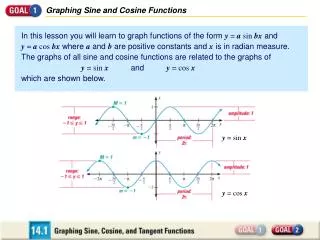
Sketch by hand • key points • x-intercepts • minimums • maximums
Sine Function-Keys Maximum (/2, 1) Intercept ( , 0) Intercept (2, 0) Intercept (0, 0) Minimum (3/2, - 1)
Cosine Function --Keys Maximum (0, 1) Maximum (2, 1) Intercept (3/2, 0) Intercept (/2, 0) Minimum (, -1)
Sketch the graph of y = 2 sin x • first remember y = 2 sin x means • y = 2(sin x)
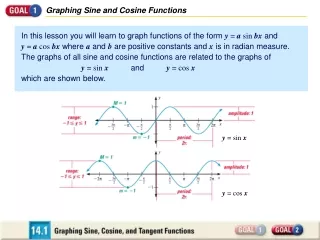
Amplitude • y = a sin x • y = a cos x • a is a scaling factor or amplitude • |a| > 1 is a vertical stretch • |a| < 1 is a vertical shrink • range is –a ≤ y ≤ a
Period • is the distance from any point on the graph to a corresponding point on the graph • usually measured from a key point • period = 2/b • y = a sin bx • y = a cos bx • b = 1 on parent functions
Period • if 0 < b < 1, the period is greater than 2 • and represents a horizontal stretch • if b > 1, the period is less than 2 • and represents a horizontal shrink
Find the period • y = sin x/2 • period = 2/b • x/2 = (1/2)x = bx • so b = ½ so • period = 2/(1/2) = 4 • y = cos x/4 • period = 8 • y = sin 2x • Period =
Horizontal stretching • sketch y = sin x/2 • determine period • plot x = period • divide x-axis into 4 even parts • sketch the parent function over the new period
Translations • y = a sin (bx – c) and y = a cos (bx – c) • creates a horizontal translation of the parent functions of sine and cosine • the graph completes one cycle from • bx – c = 0, the left end point • to bx – c = 2, the right end point
Find the left and right endpoint, also the period • y = sin(x - /3) • y = cos(2x - /4) • y = cos(x/2 - /4)
What is the difference between • y = sin(x/3 + ) • y = 2 + sin(x/3 + ) • since the 2 is being added to the y value • the entire graph is translated up 2 (y) units • y = cos (2x + /2) • y = - 3 + cos (2x + /2) • the entire graph is translated down 3 units
y = d + a sin (bx – c) • d is the vertical translation • a is the amplitude, 2a is the total vertical movement • b modifies the period, period = 2/b • c is the horizontal translation • bx – c = 0 is the left endpoint of a period • bx – c = 2 is the right endpoint of a period • all of the above is true for cosine