Periodic Table
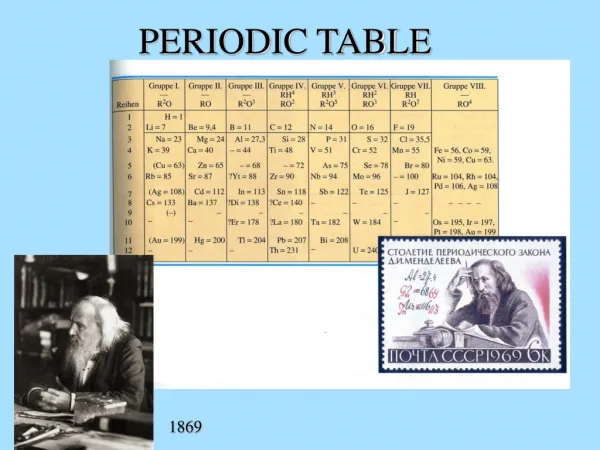
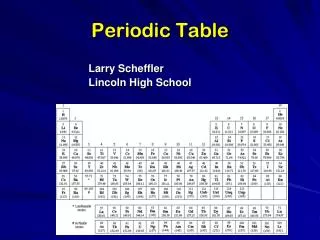
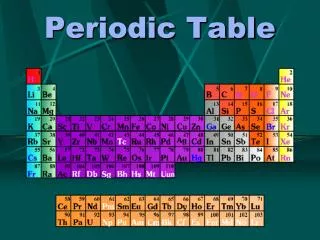
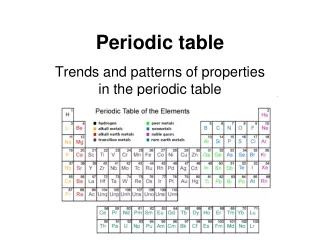
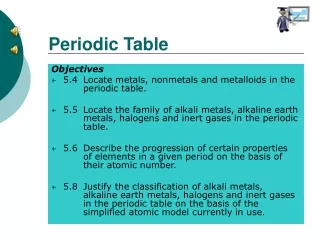
The periodic table organizes elements based on atomic number and properties. Elements are grouped according to shared characteristics—Group 1 includes highly reactive alkali metals, Group 2 consists of less reactive alkali earth metals, Group 7 features halogens that are poisonous gases, and Group 8 comprises non-reactive noble gases. Metals are typically solid, shiny, and good conductors of electricity, while non-metals are generally gases or liquids and poor conductors. This foundational knowledge is crucial for understanding chemical interactions and reactions.

Periodic Table
E N D
Presentation Transcript
The Table • Increase in Atomic Number 3 4 5 10 11 14 18 19 33 89
Groups • All in the same group have the same properties Group 1 Alkali Metals Very reactive
Groups • All in the same group have the same properties Group 2 Alkali Earth Metals Less reactive
Groups • All in the same group have the same properties Group 7 Halogens Poisonous Gases Cleans Water
Groups • All in the same group have the same properties Group 8 Noble Gases Non-reactive Glow with electricity
Groups • All elements in the same group have the same properties Group 8 Noble Gases Non-reactive Glow with electricity Group 2 Alkali Earth Metals Less reactive Group 7 Halogens Poisonous Gases Cleans Water Group 1 Alkali Metals Very reactive
Properties of Metals Non-metals are mostly gases and liquids and most do not conduct electricity. Dull and brittle. Metals are mostly Solids and conduct electricity. Shiny and hard. Mix 2 together and form an ALLOY.
Alloys • Two metals mixed together • Some of both properties • Brass – Copper and Zinc • Bronze – Copper and Tin • Stainless Steel – Chromium and Iron (and carbon)
Extraction • Removing metal from it’s ORE A lot of history is decided by getting Metals from stones
Conduction • All metals conduct electricity Moving electrons carry the charge
Metals conduct electricity The Light bulb shows electrons flow Non-metals are insulators No flow of electrons
Summary • Groups • Metals and non-metals
H/W • P 188 • Q 1 to 6