Download
1 / 7
0 likes | 0 Views
Discover how server components and edge rendering are reshaping front-end architecture in 2026. This in-depth guide explains how modern websites achieve up to 70% faster load times, improved SEO rankings, and reduced infrastructure costs. Learn component-driven development, edge CDN deployment strategies, and scalability best practices to build high-performance, future-ready web applications.

E N D
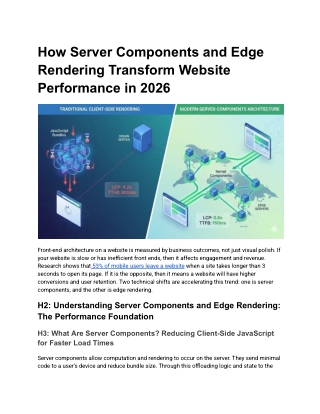
How Server Components and Edge Rendering Transform Website Performance in 2026 Front-end architecture on a website is measured by business outcomes, not just visual polish. If your website is slow or has inefficient front ends, then it affects engagement and revenue. Research shows that 53% of mobile users leave a website when a site takes longer than 3 seconds to open its page. If it is the opposite, then it means a website will have higher conversions and user retention. Two technical shifts are accelerating this trend: one is server components, and the other is edge rendering. H2: Understanding Server Components and Edge Rendering: The Performance Foundation H3: What Are Server Components? Reducing Client-Side JavaScript for Faster Load Times Server components allow computation and rendering to occur on the server. They send minimal code to a user’s device and reduce bundle size. Through this offloading logic and state to the
server, the modern applications are able to cut unnecessary JavaScript execution, which directly improves key performance metrics like Largest Contentful Paint and Time to Interactive. When these two are positively affected, then user engagement and SEO performance become good. H3: What Is Edge Rendering? Bringing Content Closer to Global Users Edge rendering complements server components by moving rendering work closer to users. It executes logic in geographically distributed locations instead of making every request to a centralized data center. This reduces latency and time to the first byte (TTFB), which makes global performance more predictable and consistent. In modern times, edge-first delivery is projected to be the default deployment target for a site’s framework that focuses on performance and scalability. For businesses, this architectural shift in a website is essential, as front-end choices influence SEO visibility, infrastructure costs, content update velocity, and customer satisfaction. Firms that ignore architecture risk losing business. The advice is to turn the front end into a strategic asset. But get the job done professionally, like most businesses that reach out to a website design company in India, who support their growth. To understand why this matters and how a modern front end can boost performance and business results, we first need to explore how server components fit into modern architecture.
H2: Server Components in Modern Front-End Architecture: Benefits for Business Performance Now that performance and scalability are clearly tied to business outcomes, the next step is to understand how server components reshape front-end architecture at a structural level. H3: Key Benefits: Security, Scalability, and Maintainability Having server components means gaining clarity in a website's architecture. Business logic, data access, and sensitive operations remain on the server, while the browser focuses on presentation. This separation improves security, simplifies debugging, and reduces the risk of performance bottlenecks caused by heavy client-side scripts. For growing websites, server components support better scalability. Also, content-heavy pages, dashboards, and dynamic interfaces can be rendered efficiently without increasing browser complexity. This makes maintenance easier as the application evolves. Given the benefits of server components, businesses want professionals to integrate them into their modern front-end systems. Now, it is not about designing interfaces alone, as having a site built withan architect server-driven front ends has become essential to develop fast, scalable, and future-ready digital products. H2: Edge Rendering Strategy: Reducing Latency for Global Website Performance After server components, edge rendering takes performance optimization a step further. They reduce the distance data travels before a rendering reaches the user. Edge rendering does not route each request to a central data center, but executes parts of a site’s logic at locations close to users. This improves a site's speed and real-world performance consistency. Research shows that every 100 millisecond (ms) reduction in Time to First Byte (TTFB) can significantly boost engagement and conversion likelihood. While exact figures vary by industry, studies consistently link faster server responses with better business outcomes (https://wearetenet.com). H3: How Edge CDN Networks Deliver Faster Time to First Byte (TTFB) Edge rendering uses networks of distributed servers that are also known as CDN edge nodes. These nodes preassemble HTML and critical data. When a user requests a page from Mumbai, Dubai, or London, the nearest edge location serves such a response. Using this strategy reduces latency, lowers TTFB, and lightens the load on origin servers. For example, sites using platforms such as Cloudflare Workers, Vercel Edge Functions regularly demonstrate TTFB improvements of 50 to 300 ms compared to centralized servers. Depending
on the region and traffic pattern, this is a benefit that translates to faster content display, especially for global audiences. H3: Edge Rendering Impact on SEO Rankings and User Experience Faster delivery impacts a website’s SEO. Search engines are increasingly measuring real-world page experience in rankings. For businesses, edge rendering is now a differentiator as it shows architectural maturity and readiness to deliver fast experiences worldwide. You need to understand that front ends aren’t just client code and visuals, but are globally distributed systems. So, edge-aware delivery makes websites faster, more resilient, and better positioned for growth. H2: Front-End Architecture Decisions: Impact on Scalability and Infrastructure Costs Once performance is distributed through server components and edge rendering, the next challenge businesses face is scale. Front-end architecture decisions directly determine how well a website will grow with traffic, content, and feature complexity.
H3: Component-Driven Architecture vs. Traditional Page-Based Systems Modern front ends are increasingly built around component-driven systems instead of rigid page templates. Here, teams work with reusable components to maintain consistency while reducing duplication across the codebase. When the site expands, this approach does not call for a site rework and keeps design updates predictable. As for the page-based builds, they often scale poorly. Each new feature added here introduces more client-side logic, duplicated styles, and additional scripts. This leads to heavier bundles, slower load times, and rising maintenance costs. H3: Optimizing Data Fetching, Caching, and Rendering for Cost Efficiency Architecture defines how data is fetched and cached. Here, server-first data access allows content to be retrieved once, cached intelligently, and reused across sessions. When the server is first combined with edge caching, this reduces repeated server computation and bandwidth usage. Poor data strategies lead to unnecessary operational costs. With excessive API calls, inefficient caching, and unnecessary client-side fetching, they force servers to work harder as traffic grows. These inefficiencies may go unnoticed, but become expensive when done so at a later phase.
For this reason, architecture must balance performance, maintainability, and cost efficiency from the start. H2: Why Hire Professional Developers for Server-Side Rendering Architecture As front-end architecture becomes more complex, businesses are reassessing who builds their digital platforms. This shift towards having a site with server components, edge rendering, and performance-first systems has increased the demand for professionals who understand architecture, and not just interface design. Companies are turning to website design companies in India, as they know how to balance between technical depth and cost efficiency. Their expertise allows businesses to adopt modern architectures without excessive development overhead. Another factor is experience at scale. Many website design companies in India work with global clients. This exposure enhances their expertise around performance tuning, caching strategies, and scalable component systems. Also, productivity plays a major role in making future-ready front ends. Here, the pros integrate modern tooling and optimized workflows that reduce development cycles while maintaining code quality. Companies that can maintain front ends are capable of handling growth without the need for frequent architectural rewrites.
H2: Key Takeaways: Implementing Modern Front-End Architecture Server components and edge rendering are now core to building fast, scalable websites. Businesses that invest in modern front-end architecture gain better site performance, SEO visibility, and user retention. Don’t let outdated architecture slow you down. Hire a website design company that builds a performance-driven front end.