Download
1 / 34
340 likes | 436 Views
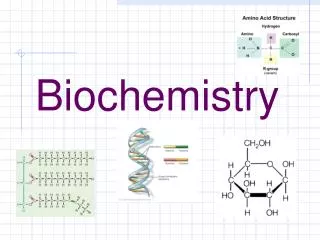
Explore the world of biochemistry through the study of giant macromolecules formed by polymerization of organic compounds like carbohydrates, proteins, lipids, and nucleic acids. Learn about their structures, functions, and importance in living organisms.

E N D
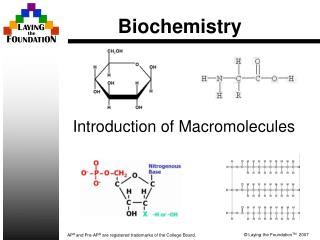
Macromolecules • Giant molecules made from thousands of smaller molecules • Formed by polymerization
Polymerization • The construction of larger compounds by joining (bonding) smaller compounds together. • Monomers=smaller compounds • Polymers=collection of smaller compounds. Monomers Polymers
Organic Compounds: • Chemical compounds containing Carbon • Also known as biomolecules
How Organic Compounds are Formed and Destroyed • Dehydration Synthesis • Hydrolysis
Dehydration Synthesis • The combination of two monomers (building blocks) to make a polymer using enzymes and losing water.
Hydrolysis • The process of breaking down a polymer (large organic molecule) into its sub units (monomers) using enzymes and water.
Bio-Molecules • Carbohydrates • Proteins • Lipids • Nucleic Acids
Carbohydrates(Sugars) • Organic compounds made up of carbon, hydrogen, and oxygen atoms, usually in a ratio of 1:2:1. (CH2O) • The monomers that make up carbs are monosaccharides • Types of Sugars: • Monosaccharides • Disaccharides • Polysaccharides
Saccharide Examples • Monosaccharides: • Examples: Glucose (C6H12O6 ), fructose(in fruits), galactose(in milk), deoxyribose, and ribose sugar • Disaccharides: • Examples: Sucrose (C12H22O11), lactose, maltose. • Polysaccharides: • Examples: Starch (C6H10O5)n , cellulose and glycogen
Carbohydrate Functions • Living things use as main source of energy • Quick energy foods (glucose, sucrose, and fructose.) • Used by cells to store and release energy. • Storage=polysaccharides (starch, glycogen) • Structure (cellulose)
Examples of Foods • Fruit • Bread • Rice • Candy/Cakes • Cereal • Potatoes • Pasta • Beans
Lipids • A group of compounds that are made mostly of carbon and hydrogen atoms and contain very little oxygen • Insoluble in water • Examples: Fats, Steroids, Oils, and Wax • They are found surrounding internal organs, in each cell membrane, and clogging arteries and veins. • Monomers of lipids are fatty acids and glycerol
Saturated: No double bonds between the carbons Solid at room temperature Found mostly in animals. Ex: Butter Unsaturated: Double bonds between some of the carbons Liquid at room temperature Found mostly in plants Ex: Olive Oil Main Types of Fats
Lipid Functions • High Energy food, more for long term energy. • Protects vital organs • Insulates the body • Stores food for later use
Examples of Foods • Butter • Cheese • Olive Oil • Nuts
Protein • Macromolecules that contain nitrogen, carbon, hydrogen, and oxygen • Monomers of proteins are amino acids. • Approximately 20 known amino acids. • Each amino acid contains an NH2 or amino group and a CO2H or carboxyl group
Protein Functions • Movement: Makes up muscle tissue • Transport: Carries oxygen in organisms (hemoglobin). • Immunity: Helps fight off foreign invaders (antibodies). • Enzymes: Speed up chemical reactions (amylase) • Energy source • Cell movement
Examples of Foods • Chicken • Beef • Peanuts • Eggs • Fish • Turkey • Cheese • Milk
Nucleic Acids • These are chemical compounds made up of smaller units(monomers) called nucleotides. • Examples are: DNA (Deoxyribonucleic acid) and RNA (Ribonucleic acid).
DNA Double Helix Contains the sugar deoxyribose RNA Single strand Contains the sugar ribose Nucleic Acid Comparison
Nucleotide • 3 parts: • 5-carbon sugar • Phosphate group • Nitrogen base
Function • Store and transmit genetic information
Enzymes • Proteins that act as catalysts to speed up chemical reactions • Lower the amount of energy needed to start the reaction in cells • Specific and can only catalyze one chemical reaction
Enzyme Action • An enzyme binds to a substrate in a region called the active site • Only certain substrates can fit the active site • 1 enzyme will work with only 1 substance
Factors Affecting Enzyme Activity • pH • Maximum activity at optimum pH • Narrow range of activity • Most lose activity in low or high pH • Temperature • Little activity at low temperature • Rate increases with temperature increase • Most active at optimum temperatures (37°C = human) • Won’t work with too high or low temperature
pHScale • Indicates the concentration of H+ ions in a solution • Measure with pH paper
Acids • pH below 7 • Have more H+ions than OH- ions • The lower the pH, the greater the acidity • Examples: lemon juice, vinegar, stomach acid
Bases • pH above 7 • Have more OH-ions than H+ ions • The higher the pH, the more basic the solution • Examples: oven cleaner, bleach, soap, drain-o
Neutral • Concentration of H+ ions and OH- ions are equal • pH of 7 on scale • Example: pure water
pH Scale • Each pH unit is 10 times as large as the previous one • A change of 2 pH units means 100 times more basic or acidic
Buffer • Solutions that can react with strong acids or bases to prevent sudden changes in pH • The pH of most cells in the human body must generally be kept between 6.5 and 7.5. • Controlling pH is important for maintaining homeostasis.