Download
1 / 6
60 likes | 181 Views
In this session, we reflect on last week's intentions and the role of autogenics in energizing and quieting the mind. We revisit basic skills and habits necessary for enhancing our wellbeing, focusing on relationships, self-determination theory, and the importance of compassion. We discuss strategies for assessing personal relevance in our journeys and develop action plans for improvement. This session emphasizes mindfulness, emotional intelligence, and the mechanisms driving positive states. Let’s explore how to foster better relationships with ourselves and others.

E N D
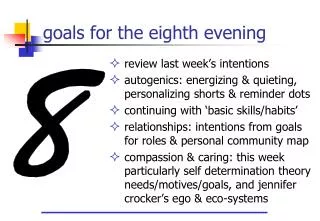
goals for the eighth evening • review last week’s intentions • autogenics: energizing & quieting, personalizing shorts & reminder dots • continuing with ‘basic skills/habits’ • relationships: intentions from goals for roles & personal community map • compassion & caring: this week particularly self determination theory needs/motives/goals, and jennifer crocker’s ego & eco-systems
1st seven sessions: progress so far how did last week’s intentions go and any lessons for this week’s intentions? • autogenics: belly focus, reminder dots, and shorter exercises • exercise: stamina, strength, quantity, variety • diet, alcohol, weight … and sleep • community map & values-roles-goals-diary
main components of the journey • basic skills: exercise, diet, weight, alcohol, smoking, sleep • meditation: autogenic training, applied relaxation, visualisation, mindfulness, compassion • relationships, emotional intelligence, social networks • wellbeing: positive emotions, self-determination, happiness
compassion & criticism key points • to understand more clearly how important these areas are for our health & wellbeing • appreciate the mechanisms that lead to compassion or criticism • explore ways to assess personal relevance of these issues • look at how we can work to improve relationships both with ourselves & with others
compassion: stages of change • precontemplation:not yet realizing how important compassion & lack of compassion are for the health of both ourselves & others • contemplation:understanding how crucial it is to reduce toxic forms of self- & other criticism, and to nourish empathy & caring, but not knowing yet how to change these engrained responses • preparation:developing an action plan that might include emotional processing, compassion training, good therapeutic relationships (individual & group) & outer behavioural changes • action:putting the plan into practice, monitoring what works and what doesn’t, adapting or adding components as needed • maintenance:putting in place check-ins, reminders & ‘fire drills’ for the expected times when one slips back into old habits
four aspects of helpful inner focus reducing negative states nourishing positive states exploring & processing encouraging mindfulness